Evidence Builds for Disrupted Mitochondria as Cause of Parkinson’s
Listen:
For decades, scientists have known that mitochondria, which produce energy inside our cells, malfunction in Parkinson’s disease. But a critical question remained: do the failing mitochondria cause Parkinson’s, or do they become damaged when brain cells die during the course of disease?
Many studies have sought to answer this question over the years. Yet, progress has been slow—in large part due to the limitations of animal models used to research this highly complex disease.
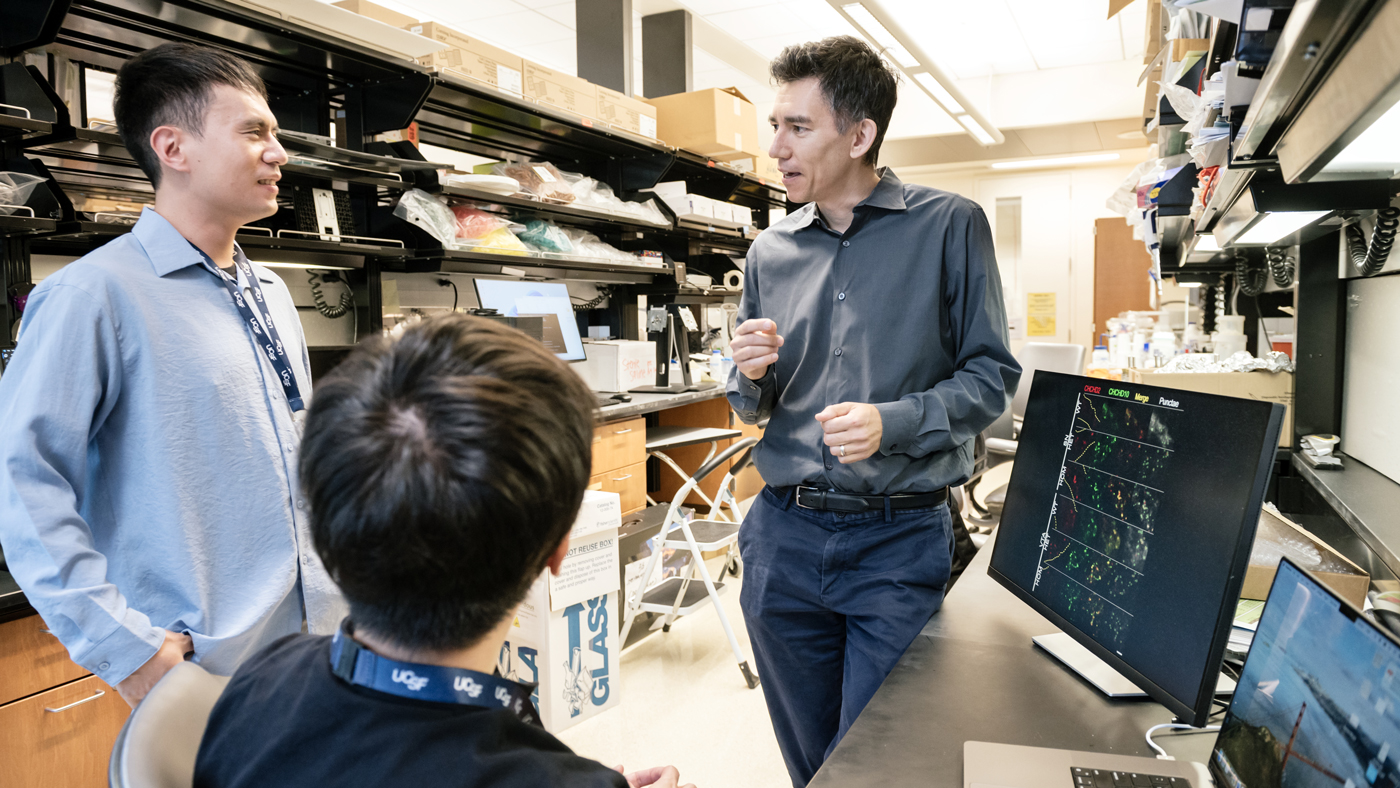
Now, a team of scientists from Gladstone Institutes has achieved a new level of clarity through discoveries demonstrating that dysfunctional mitochondria can initiate the onset of Parkinson’s.
The study, which appears in Science Advances, centers on a unique mouse model that exhibits symptoms of a rare, inherited form of Parkinson’s that is otherwise indistinguishable from the most common form, which develops later in life and accounts for about 90 percent of cases.
“This mouse model provides some of the most compelling evidence to date for how mitochondrial dysfunction can cause typical late-onset Parkinson’s disease,” says Gladstone Investigator Ken Nakamura, MD, PhD, who led the study. “I hope that ultimately, understanding this link will point to new drug targets to prevent or treat all forms of the disease.”
The mouse model used in the study carries a mutation in a mitochondrial protein known as CHCHD2, which causes a rare, inherited form of Parkinson’s. Because that variant of the disease mirrors the more common form—which is known as “sporadic” Parkinson’s—the researchers hypothesize their insights carry over to a large proportion of those cases.
Mimicking Human Disease
Parkinson’s, the second-most-common neurodegenerative disorder, affects more than 1 million people in the U.S., with most cases diagnosed after the age of 60. Over time, the brain loses its ability to produce the neurotransmitter dopamine, which helps coordinate movement. This process leads to the movement-related symptoms such as tremor, stiffness and gait problems.
However, many forms of Parkinson’s exist—and the most common sporadic form has many subtypes and underlying mechanisms driven by an array of different genetic and environmental factors.
The heterogeneity of the disease has presented challenges for researchers, and mice carrying some mitochondrial mutations that are linked to Parkinson’s disease in humans fail to develop the key features of the sporadic disease, says Nakamura, who conducts his research at the Gladstone Institute of Neurological Disease.
Using their new mouse model, the scientists were able to delineate a cascade of steps by which mitochondrial dysfunction may trigger the core cellular changes seen in people with rare or more common forms of Parkinson’s.
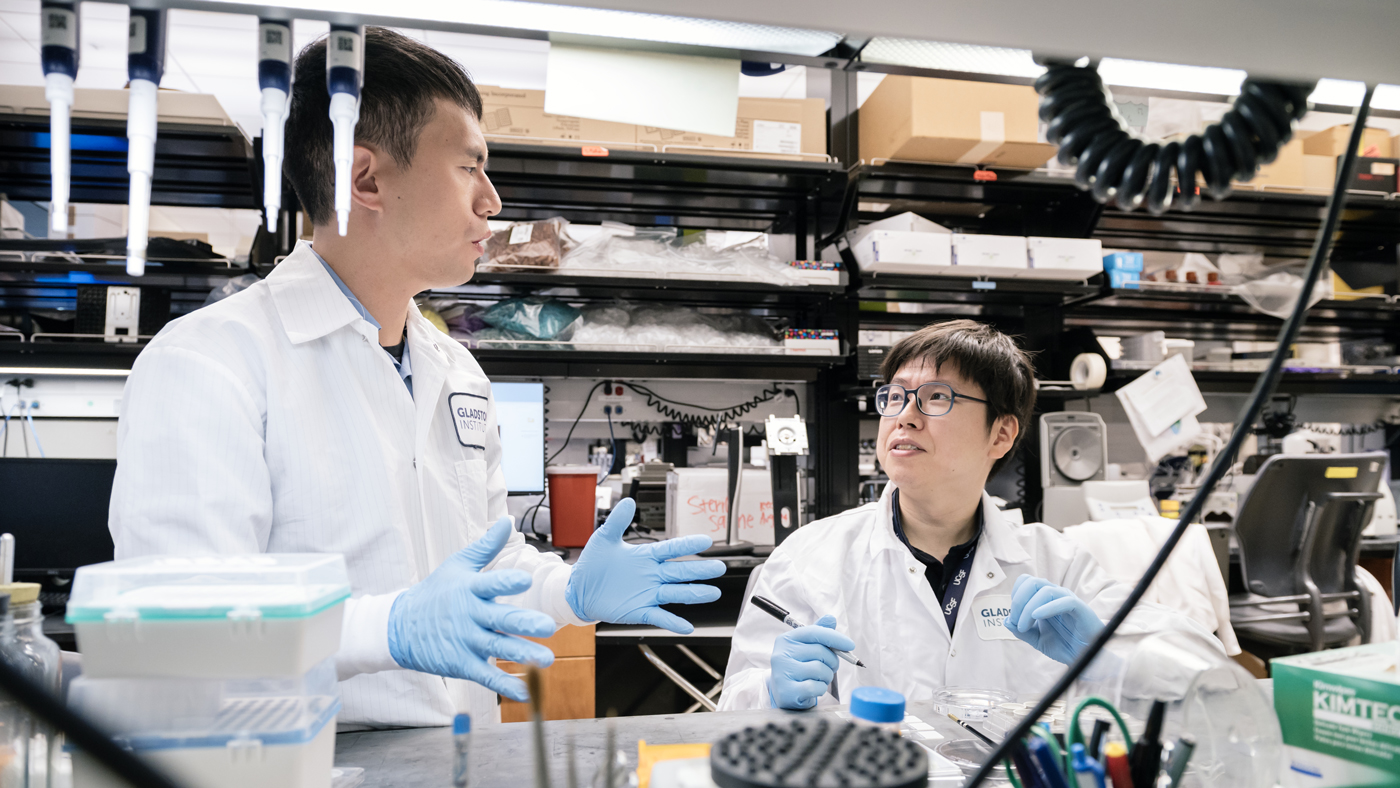
“We were able to watch, step by step, how mitochondria start to fail and how this process eventually leads to the accumulation of alpha-synuclein—the protein that builds up in pathological alterations in the brain called Lewy bodies in nearly all Parkinson’s patients,” says Kohei Kano, PhD, a postdoctoral fellow in Nakamura’s lab and a co-first author of the study.
A Perfect Storm
The researchers showed that the mutated CHCHD2 protein accumulates in mitochondria, causing them to become swollen and distorted. Over time, cells with these dysfunctional mitochondria stop using their normal energy-production pathways, shifting to less-efficient means of burning sugar.
As the mitochondrial metabolism shifts, oxidative stress increases within cells due to a buildup of unstable molecules known as reactive oxygen species. The reason for this appears to be that the CHCHD2 mutation interferes with proteins that normally clean up the destructive molecules.
“A notable finding was that alpha-synuclein doesn’t accumulate until after levels of reactive oxygen species rise,” says co-first author Szu-Chi Liao, PhD, a former member of the Nakamura lab who is now at UC San Francisco. “This order of events is consistent with our hypothesis that oxidative stress is causing the alpha-synuclein to aggregate.”

Broader Lessons for Parkinson’s
To confirm their findings in humans, Nakamura collaborated with scientists at the University of Sydney in Australia to examine post-mortem brain tissue from people with sporadic Parkinson’s. The Sydney team, led by Glenda Halliday, PhD, found that the CHCHD2 mitochondrial protein accumulated in early-stage aggregates of alpha-synuclein within vulnerable dopamine-producing neurons in the human patients.
“This work is a blueprint for how a mitochondrial protein can be disrupted and actually cause Parkinson’s disease,” Nakamura says. “But there could be other triggers that set off this same sequence of events involving mitochondrial damage, energy problems, the accumulation of reactive oxygen species, and finally, abnormal accumulation of additional proteins.”
The scientists are now planning additional studies to understand how CHCHD2 influences oxidative stress and whether it may contribute to the development of sporadic Parkinson’s. They also aim to investigate if drugs that block reactive oxygen species and boost cellular energy could stop the chain of events that lead to disease.
Up Next

Overworked Brain Cells May Burn Out in Parkinson’s Disease
A discovery about the consequence of neuron overactivity could lead to new methods of treating or preventing Parkinson’s disease.
Inside the Brain: Tackling Neurological Disease at Its Roots
For World Brain Day, discover some of Gladstone’s latest breakthroughs in neurological research.

A New Era of Treating Neurological Diseases at the Blood-Brain-Immune Interface
Gladstone scientists say it’s time to think differently about how to define and treat diseases such as Alzheimer’s and multiple sclerosis.

Meet Gladstone: Yanilka Soto-Muñiz
Yanilka Soto-Muñiz, a graduate student in Ken Nakamura’s lab, shares her journey from Puerto Rico to neuroscience research, highlighting her inspiration from women in science, her resilience after Hurricane Maria, and her dedication to understanding neurological diseases

Get Involved
Join the Team
Our people are our most important asset. We offer a wide array of career opportunities both in our administrative offices and in our labs.
Open PositionsPartner With Us
Discoveries don’t stay in our labs. Gladstone facilitates spinout companies to advance promising therapies, shortening the path between scientific discovery and helping real patients.
Learn MoreGive
Your gift to Gladstone will allow our researchers to pursue high-quality science, focus on disease, and train the next generation of scientific thought leaders.
Donate Now