Gladstone NOW: The Campaign Join Us on the Journey✕





Gladstone scientists and their collaborators are entering a new era of HIV research by uniting the power of single-cell sequencing, organoids, and artificial intelligence.
Listen to this article
For decades, HIV has been a master saboteur, secretly rewiring immune cells on a microscopic scale without leaving a clear trail. But now, a multi-institutional collaboration co-led by scientists at Gladstone Institutes is launching a major initiative to uncover the virus’s hidden blueprint and expose exactly how it compromises human immunity.
Powered by a $2-million award from amfAR, the Foundation for AIDS Research, the team of scientists will construct a comprehensive, single-cell-resolution “atlas” of how HIV affects the entire immune system.
The three-year program, known as the HIV Immune Atlas Study, seeks to create a crucial scientific resource that could accelerate the development of more effective treatments—and potentially a cure.
“To really move the needle on HIV research, the scientific community needs better, more detailed tools,” says Nadia Roan, PhD, senior investigator at Gladstone and a lead investigator of the study. “This grant from amfAR allows us to bring some of the best minds in the field together to build the HIV Immune Atlas. Our goal is to provide researchers everywhere with a powerful, open-access resource that completely changes how we study the virus’s impact on the body.”
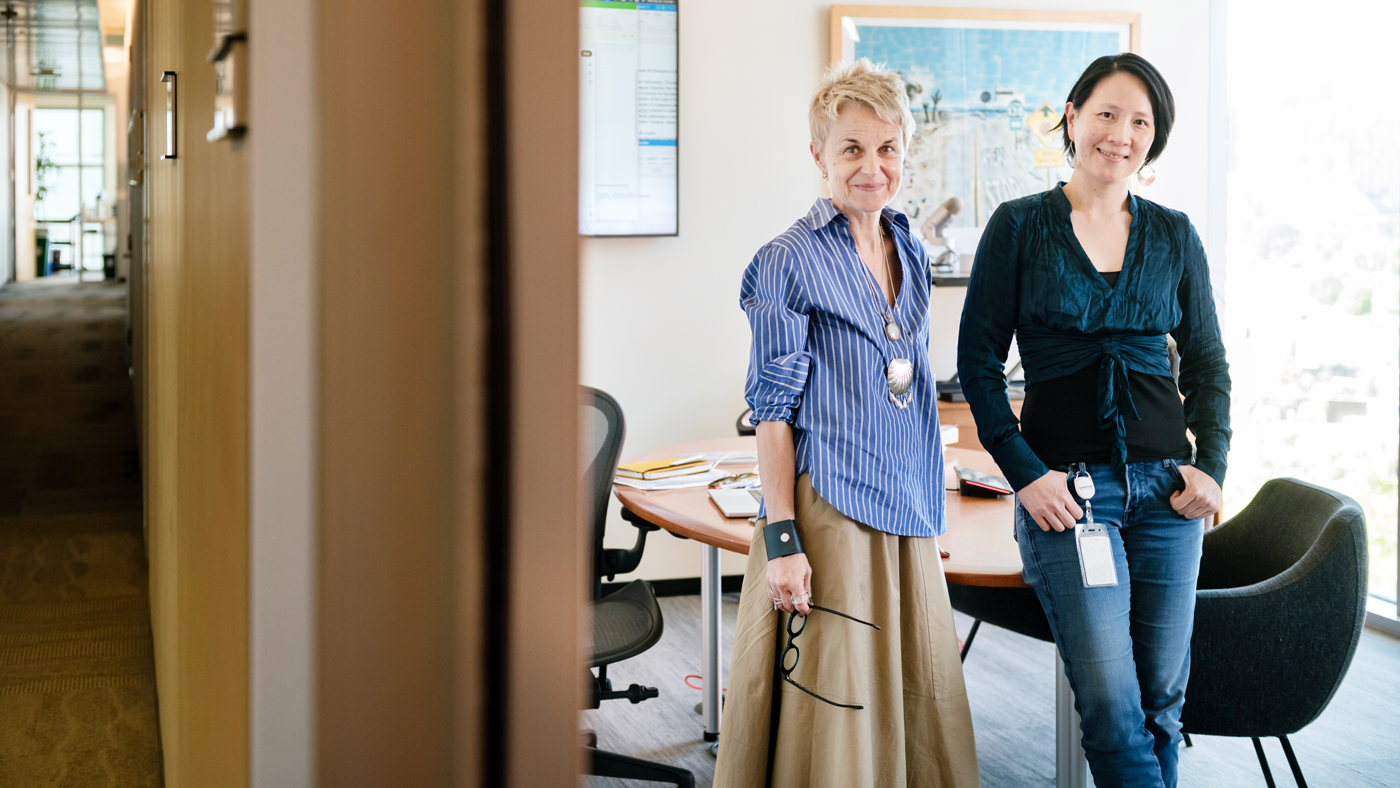 Ott (left) and Roan (left) are part of a major initiative to map where HIV hides within different types of cells and how it evades detection from the immune system, with the goal of creating new strategies to eliminate the HIV reservoir.
In addition to Roan’s lab, the study includes the team of Melanie Ott, MD, PhD, director of the Gladstone Infectious Disease Institute and the Nick and Sue Hellmann Distinguished Professor at Gladstone. Beyond Gladstone, investigators include Brad Jones, PhD, of Weill Cornell Medicine; Jeffrey Johnson, PhD, of the Icahn School of Medicine at Mount Sinai; and Fabian Theis, PhD, of Helmholtz Munich.
“We’ve reached a turning point where tools like AI and single-cell sequencing are completely redefining what’s possible in virology,” Ott says. “By uniting these technological advancements, we can finally open the black box of how HIV alters the immune system on a cellular level. This is about getting answers that apply to real people, from all backgrounds and treatment histories.”
Why Build an HIV Immune Atlas?
About 40 million people around the world currently live with HIV, and approximately 77 percent of them have access to HIV-suppressing antiretroviral therapy. While antiretroviral therapy has saved millions of lives, it’s not a cure.
The treatment prevents HIV from infecting new target cells, but does not eliminate the so-called “HIV reservoir,” or the small number of infected cells that remain hidden in the body. In people with HIV who are on therapy, these infected cells still produce fragments of the virus, which can contribute to immune system dysregulation and chronic inflammation that raise the risk of such conditions as cancer and cardiovascular disease.
One key outcome of the study will be mapping out where HIV hides within different types of cells and how it evades detection from the host, with the goal of creating new strategies for eliminating the HIV reservoir.
“An ambitious project like this can’t be done in a vacuum; it requires a truly collaborative effort. Each team represents a unique, vital piece of the puzzle, and all are necessary to get to the bottom of why HIV can so successfully hide and persist in certain immune cells.”
“We’re still unlocking the mysteries of how HIV interacts with the body over time,” Roan says. “We need to understand why immune health can still falter despite antiretroviral drugs, and map out conserved features of HIV reservoir cells between individuals—and, conversely how they differ between individuals, for example between men and women. By figuring out exactly how and where HIV hides and how it disrupts everyday immune processes, we can start designing more tailored interventions.”
The team’s cellular atlas will help with these efforts. It will combine highly detailed data on individual cells, including both those directly infected with HIV and bystander cells. Through this, it will reveal precisely how different types of cells behave, interact with each other, and change with disease.
Such atlases have been developed for other diseases, and have proven to be critical tools in helping researchers discover underlying mechanisms and develop novel treatments.
“In the context of HIV, prior efforts to characterize reservoir cells were led by separate groups and have not been integrated with each other,” Ott says. “Our atlas will unite existing data, incorporate new data and technologies, and undergo updates as new data is generated and new advancements are made.”
AI-Powered Predictions
Each collaborator brings unique expertise to the HIV Immune Atlas.
At Gladstone, Roan’s team is analyzing blood and a diverse array of tissues from people with HIV from around the world. This work harnesses HIV-seq, a novel tool her team was involved in developing for single-cell RNA sequencing of rare HIV-infected cells, as well as technologies currently under development by her lab. By including specimens from people of various gender, age, ethnicities, HIV subtypes, and treatment histories, they intend to make the atlas useful for studying how HIV affects different populations, and whether some might benefit from unique treatment strategies.
“For instance, you could search the atlas by age to explore whether HIV affects the immune system differently in older as compared to younger people, or by gender to explore sex differences in HIV reservoir features” Roan says.
Ott’s team is developing HIV-infected brain and gut organoids—tiny clusters of cells that mimic traits of the real human brain and gut. These organs are crucial sites of HIV infection, but are very difficult to study when it comes to human specimens. With the three-dimensional organoids, Ott’s team is investigating HIV-infected cells and how they affect surrounding cells, applying single-cell and spatial transcriptomics. Those data can then be incorporated into the atlas for validation and further study.

The team of scientists, including Ott (left) and Roan (right), brings together advanced experimental models and AI to create an atlas that will help them answer crucial outstanding questions in the field of HIV research.
Roan’s and Ott’s teams will work closely with Jones’s lab to expand tiny populations of reservoir cells from people with HIV into millions of HIV-infected cells in the lab, as well as with Johnson’s lab, where the scientists use mass spectrometry to reveal which proteins are present in different immune cells in people with HIV. Finally, Theis and his group will apply artificial intelligence and machine-learning techniques to help integrate all of the data into a single, searchable atlas.
“An ambitious project like this can’t be done in a vacuum; it requires a truly collaborative effort,” Ott says. “Each team represents a unique, vital piece of the puzzle—transcriptomics, proteomics, AI, and experimental models like clonal cell lines and organoids—and all are necessary to get to the bottom of why HIV can so successfully hide and persist in certain immune cells.”
With AI capabilities incorporated into the atlas, researchers will be able to make predictions—perhaps about HIV’s impact on certain immune processes or the effectiveness of a novel drug—that can then be tested in a lab. Users also could virtually “perturb” cells in the atlas, activating them or suppressing them the way a drug would, to see how the rest of the immune system might respond.
“The atlas could help us answer some crucial outstanding questions, like exactly how HIV-infected cells can persist in people on antiretrovirals without being eliminated by the immune system, and whether this information can unveil the ‘Achilles heels’ of HIV reservoir cells that can be therapeutically targeted,” Roan says. “And we’re not just looking at infected cells themselves, but also their overall impact on the immune system, including what that can reveal about the mechanisms underlying the chronic inflammation and co-morbidities experienced by people with HIV despite antiretroviral therapy.”
Gladstone NOW: The Campaign
Join Us On The Journey
Long COVID and Immune 'Soldier' Cells: A Q&A With Gladstone’s Nadia Roan
Article
July 29, 2026
Long COVID and Immune 'Soldier' Cells: A Q&A With Gladstone’s Nadia Roan
New research links long COVID to changes in virus-specific immune cells, particularly in women.
Roan Lab COVID-19 Infectious DiseaseScience in Seconds | A New Path Toward Life Without Daily HIV Pills

Video
March 20, 2026
Science in Seconds | A New Path Toward Life Without Daily HIV Pills
In this video, Nadia Roan and Ashley George explain how they uncovered a new path toward long-term health without the need for daily HIV pills.
Gladstone Experts Research (Publication) HIV/AIDS Infectious Disease Roan LabWhy Some People Naturally Control HIV Even After Stopping Therapy—and How We Can Leverage That to Treat Others
Article
March 20, 2026
Why Some People Naturally Control HIV Even After Stopping Therapy—and How We Can Leverage That to Treat Others
New research offers a path toward life without daily HIV pills, suggesting common diabetes pill could help achieve long-term remission.
News Release Research (Publication) HIV/AIDS Infectious Disease Roan Lab