Gladstone Institutes Responds to COVID-19 Pandemic

In response to the COVID-19 pandemic, Gladstone scientists have rapidly pivoted the focus of their research labs to the novel virus, SARS-CoV-2. Specifically, they are leveraging their established tools, unique infrastructure, and diverse expertise in virology to develop improved diagnostics, identify targeted treatment strategies, and invent preventative approaches. Gladstone scientists were instrumental in converting HIV/AIDS from a uniformly lethal disease into a chronic condition, and are now bringing the same urgency and focus to combatting COVID-19 in a comprehensive manner. A few examples are detailed below.
- DIAGNOSTICS—Jennifer Doudna, PhD, co-inventor of CRISPR technology, and virologist Melanie Ott, MD, PhD, are collaborating to develop a CRISPR-based method to rapidly measure COVID-19 RNA. By combining the technique with iPhone technology, they aim to develop a diagnostic that could deliver rapid results and be widely deployed even far from traditional labs, such as in airports and other ports of entry, and in remote communities throughout the world.
- TREATMENT—Nevan Krogan, PhD, has discovered all of the human host cell proteins that the virus interacts with to hijack the cell’s machinery. These proteins serve as novel targets for drug therapies. Since the high fatality rate is driven by respiratory and cardiac failure, Melanie Ott, Bruce Conklin, MD, and Todd McDevitt, PhD, will test effects of the virus and drug candidates in human lung “organoids” and human heart cells, both developed from human stem cells. Virologist Warner Greene, MD, PhD, is reconfiguring an HIV entry/fusion assay to study entry of the virus into host cells mediated by the Spike protein of SARS-CoV-2. His team will screen a library of FDA-approved drugs to identify those that could be rapidly repurposed as a treatment for COVID-19 patients or even as a preventive for high risk-groups. The assay could also be used to select the best plasma samples donated by people who have recovered from COVID-19 for infusion into seriously ill patients.
- PREVENTION—Leor Weinberger, PhD, has pioneered an innovative approach to fighting the spread of viral pathogens called therapeutic interfering particles (TIPs), which could be an alternative to a vaccine. TIPs are defective viral particles that mimic the virus but are ineffective in replicating. They turn the tables on the virus by hijacking its machinery to transform virus-infected cells into factories that produce even more therapeutic particles, amplifying the effect of TIPs in stopping the spread of virus. TIPs targeting COVID-19 would transmit along the same paths as the virus itself, and thus provide protection to even the most vulnerable populations.
This work is made possible in part because Gladstone has biosafety level 3 (BSL-3) facilities on-site, which are now dedicated to work on COVID-19. The BSL-3 research will be overseen by Melanie Ott, in partnership with UC San Francisco and its Institutional Biosafety Committee and Director of High Containment Laboratories.
In the coming weeks Gladstone will open a Biosafety Level 3 (BSL-3) lab which will allow researchers to carry out research with live viruses while keeping themselves, the building, and the environment safe from contamination. Melanie Ott, MD, PhD, and BSL-3 Lab Director Mauricio Montano answer some of the questions around this decision and its potential impact.
About Gladstone Institutes
To ensure our work does the greatest good, Gladstone Institutes focuses on conditions with profound medical, economic, and social impact—unsolved diseases. Gladstone is an independent, nonprofit life science research organization that uses visionary science and technology to overcome disease. It has an academic affiliation with UC San Francisco.
Up Next
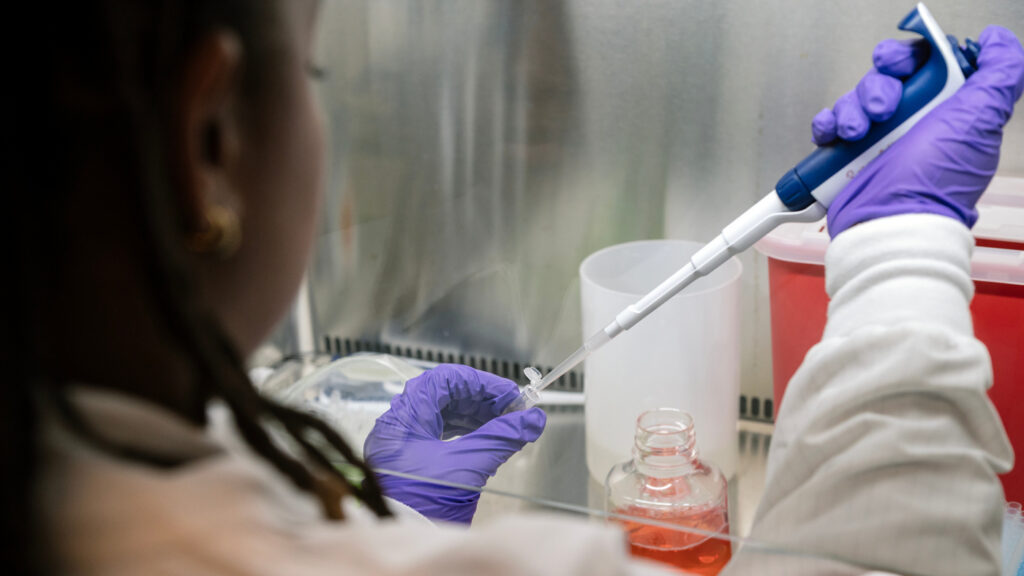
Long COVID and Immune ‘Soldier’ Cells: A Q&A With Gladstone’s Nadia Roan
New research links long COVID to changes in virus-specific immune cells, particularly in women.

Gladstone Scientists Are Awarded $2 Million to Map How HIV Affects the Immune System
By uniting the power of single-cell sequencing, organoids, and artificial intelligence, scientists are entering a new era of HIV research.
New CRISPR Technique Selectively Shreds Cancer Cells, Including Those of ‘Undruggable’ Cancers
An innovative chromatin-shredding technique shown to destroy cancer cells carrying a prevalent mutation while keeping healthy cells intact.
Gladstone Launches Center for PhAIge Therapy to Harness AI in the Fight Against Drug-Resistant Infections
The center, funded by an NIH grant, will become one of three national centers dedicated to accelerating the development of phage therapy.

Get Involved
Join the Team
Our people are our most important asset. We offer a wide array of career opportunities both in our administrative offices and in our labs.
Open PositionsPartner With Us
Discoveries don’t stay in our labs. Gladstone facilitates spinout companies to advance promising therapies, shortening the path between scientific discovery and helping real patients.
Learn MoreGive
Your gift to Gladstone will allow our researchers to pursue high-quality science, focus on disease, and train the next generation of scientific thought leaders.
Donate Now