Gladstone NOW: The Campaign Join Us on the Journey✕




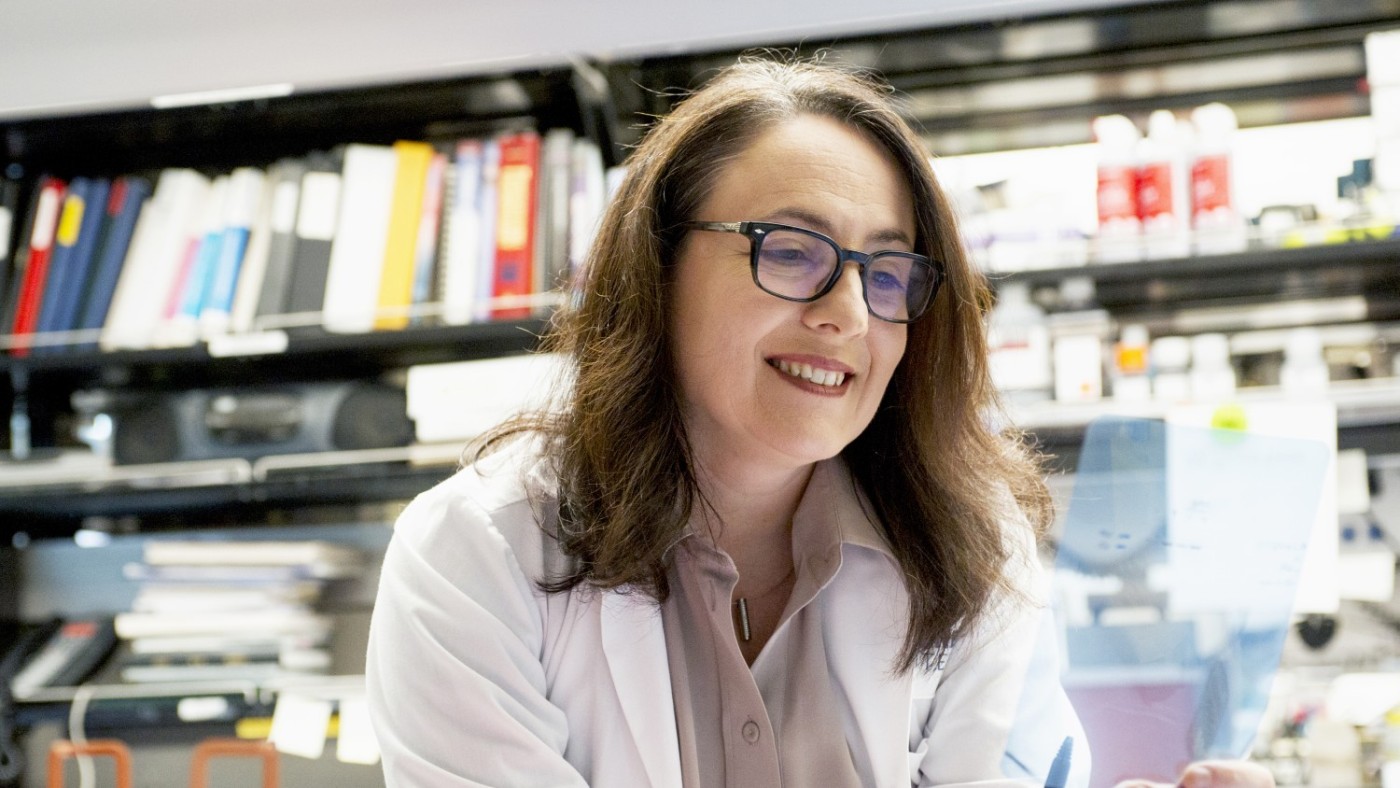
Gladstone Institutes' Katerina Akassoglou, PhD, has pioneered research into interactions between the brain, blood vessels, and immune system—and has shown how those interactions drive Alzheimer’s and other neurological diseases. She is a 2025 recipient of the Alzheimer's Association's Zenith Fellows Award.
Listen to this article
The Alzheimer’s Association has selected Gladstone’s Katerina Akassoglou, PhD, as a 2025 recipient of the Zenith Fellows Award, an international prize given annually to scientists making substantial contributions to the field of Alzheimer’s research.
A senior investigator at Gladstone Institutes and director of the Gladstone-UCSF Center for Neurovascular Brain Immunology, Akassoglou has pioneered research into interactions between the brain, blood vessels, and immune system—and has shown how those interactions drive the development and progression of Alzheimer’s and other neurodegenerative diseases.
“Katerina Akassoglou’s research exemplifies the type of bold, innovative science that brings us closer to effective treatments and, ultimately, a world without Alzheimer’s and other dementias,” says Heather Snyder, PhD, the Alzheimer’s Association’s senior vice president of medical and scientific relations.
The Zenith Fellows Awards are among the most prestigious worldwide for Alzheimer's and dementia science. With funding from Zenith Society members, the program has provided more than $48 million in awards to 152 leading Alzheimer’s researchers in nine countries since 1991.
The awards are supported philanthropically by members of the Alzheimer’s Association Zenith Society, who have an exceptional commitment to the advancement of Alzheimer’s and other dementia research. The society’s mission aligns closely with Gladstone’s Alzheimer’s research program, which is dedicated to uncovering the root causes of neurodegeneration and advancing therapies that address disease mechanisms at their source.
Revealing the Role of Fibrin
Among Akassoglou’s most significant findings, she and her team discovered that Alzheimer’s, multiple sclerosis, and other neurological conditions share a common thread: a toxic immune reaction caused by blood that leaks into the brain through damaged blood vessels. She identified fibrin as the main culprit, and demonstrated that this blood-clotting protein hijacks the brain’s immune system—setting off a cascade of often-irreversible processes that damage neurons.
With this knowledge, Akassoglou developed a new immunotherapy to neutralize the toxic effects of blood in the brain. A humanized version of the fibrin-targeting immunotherapy is now in clinical trials in patients with Alzheimer’s disease and diabetic macular edema. In mouse models, the therapy protected against neuroinflammation, neurodegeneration, and disease progression.
But this is only the start.
The Zenith Fellows Award provides $450,000 in research funding, which Akassoglou will use to further unravel the mechanisms of cerebrovascular dysfunction in Alzheimer’s disease.
Her studies will fill major gaps in knowledge—particularly related to the connections between blood vessel damage and neuronal impairments in Alzheimer’s. This research seeks to uncover how our brain, immune system, and vascular systems communicate with each other, with the goal of developing novel approaches for treating and preventing disease.
“Our discoveries into the role of fibrin in Alzheimer’s and other neurological diseases is only the beginning,” says Akassoglou, a member of the Gladstone Institute of Neurological Disease. “So much remains to be known about how our immune system and vasculature control brain-body communication. I look forward to deepening our understanding of these reciprocal connections that play a critical role in neurological disease.”
Enduring Leadership in Alzheimer's Research
“Given the estimate that more than one in 10 people over the age of 65 are living with the disease in the U.S. alone, the importance and urgency of Alzheimer’s research has never been greater,” says Lennart Mucke, MD, director of the Gladstone Institute of Neurological Disease and a previous recipient of the Zenith Fellows Award. "The breakthroughs our investigators are making give me great hope that real solutions are coming into sight and that we’ll soon have much better ways to treat and prevent Alzheimer’s disease, as well as other major brain disorders.”
Mucke adds that the latest Zenith Award to Akassoglou highlights the perfect match between the vision of the Zenith Society's members and the groundbreaking science at Gladstone. In addition to Akassoglou and Mucke, Gladstone investigator Karl Weisgraber, PhD, (now retired) also was a recipient of a Zenith Award, demonstrating Gladstone’s longstanding leadership in Alzheimer’s research.
Other prestigious awards Akassoglou received in the past include the Barancik Prize, which is the highest honor from the National Multiple Sclerosis Society, election as a lifetime fellow of the American Association for the Advancement of Science (AAAS), and elections to the National Academy of Inventors and the American Neurological Association.
For Media
Kelly Quigley
Director, Science Communications and Media Relations
415.734.2690
Email
About Gladstone Institutes
Gladstone Institutes is an independent, nonprofit life science research organization that uses visionary science and technology to overcome disease. Established in 1979, it is located in the epicenter of biomedical and technological innovation, in the Mission Bay neighborhood of San Francisco. Gladstone has created a research model that disrupts how science is done, funds big ideas, and attracts the brightest minds.
The 2026 Ogawa-Yamanaka Stem Cell Prize Awarded to Jun Takahashi

Article
September 14, 2026
The 2026 Ogawa-Yamanaka Stem Cell Prize Awarded to Jun Takahashi
Takahashi is recognized for his pioneering work translating iPS cell technology into a clinically approved therapy for Parkinson’s disease.
Ogawa Stem Cell Prize Stem Cells/iPSCs Regenerative Medicine News Release AwardsAmerican Heart Association Honors Benoit Bruneau with 2026 Distinguished Scientist Award

Article
July 30, 2026
American Heart Association Honors Benoit Bruneau with 2026 Distinguished Scientist Award
Bruneau, director of the Gladstone Institute of Cardiovascular Disease, will receive the association’s highest scientific honor in November.
News Release Congenital Heart Disease Cardiovascular Disease AwardsGladstone Institutes Receives National Recognition for Excellence in Postdoc Programs
Article
July 6, 2026
Gladstone Institutes Receives National Recognition for Excellence in Postdoc Programs
Gladstone is one of only 12 institutions nationwide to receive the award for its postdoctoral programs.
News Release Postdoctoral and Graduate Student Education and Research Development Affairs Graduate Students and Postdocs Postdoc Advisory Committee Awards