Gladstone NOW: The Campaign Join Us on the Journey✕





Even when HIV is controlled with therapy, the virus hides in pockets throughout the body, causing chronic inflammation and other health issues. That's one of many reasons we must find a cure, says Gladstone's Melanie Ott.
Over the past 45 years, the scientific and medical community achieved a miracle. We turned HIV/AIDS from a death sentence into a manageable, chronic condition—chiefly through the development of highly active antiretroviral therapy.
It’s one of the greatest victories in healthcare history, but it’s no longer enough. Today, we need a cure.
As valuable as antiretroviral therapy is, these drugs are maintenance tools that must be taken for life. If people with HIV stop taking the drugs for any reason, the virus roars back, usually with lethal force.
And even when therapy makes HIV undetectable in people, the virus isn’t really gone. It hides in pockets throughout the body, triggering chronic inflammation that damages the heart and brain, causing even people with well-controlled HIV to age prematurely and die younger than they should.
A Fragile Safety Net
But one of the biggest problems with antiretroviral therapy is that it isn’t reliably available to those who need it.
The infrastructure that ensures people with HIV can receive medication is faltering today. As a result, millions of people in Africa—which bears the greatest global burden of HIV—were without therapy last year. For some, supply has not been restored. This has a cascading effect around the world, including here in the United States.
The program known as PEPFAR—short for the “President's Emergency Plan for AIDS Relief,” launched by George W. Bush in 2003—transformed the global HIV epidemic and is credited with saving more than 26 million lives in Sub-Saharan Africa. However, this program not only faces significant uncertainty and funding pressure today, but the recent dismantling of the U.S. Agency for International Development (USAID), the main government agency implementing PEPFAR, has created interruptions in medication supply.
As a result, access to HIV prevention, diagnostics, and treatment dropped suddenly, fueling more infections and causing premature deaths. Pregnant women will pass the virus to their offspring. Sexual partners will be more vulnerable to HIV without access to the highly effective preventative drug known as PrEP (pre-exposure prophylaxis). I fear the current landscape will set us back many years in the roadmap to global HIV containment and management.
Many people in Africa are responding to HIV drug shortages by creating their own drug schedules, stretching their medications for as long as they can. This only makes matters worse: poorly suppressed HIV can foster the development of resistant strains of the virus, which are difficult or impossible to treat with existing medicines.
Not Just an HIV Problem
Under-treated HIV can also drive another viral scourge: COVID-19.
Pandemics are often interconnected, and one of the best ways to protect ourselves from COVID is to fully address HIV. Because insufficient management of HIV leads to a severely weakened immune system, the virus that causes COVID can chronically circulate and evolve in those who aren’t on antiretroviral therapy.
This mechanism may have led to the highly transmissible Omicron variant that emerged in 2021, and it will no doubt generate other dangerous new strains of viruses that make their way around the world. In fact, a third wave of Omicron is currently moving towards the U.S.
Like many, I wish we could fully restore funding to essential global health programs and get lifesaving drugs to the people who need them. However, these good intentions are not enough. We need to create a world where antiretroviral therapy is no longer subject to public policy whims.
The good news is we’re getting closer to a cure.
The Strategy: Putting HIV to Sleep
My research team, along with other labs at Gladstone, Weill Cornell Medicine, UF Scripps Biomedical Research, Yale University School of Medicine, and other institutions, have come together to eradicate HIV. We created an NIH-funded research consortium called the Hope Collaboratory, which is pursuing a novel strategy that we believe will lead to a cure.
The secret sauce is evolution. Around 8 percent of our DNA is made up of endogenous retroviruses—viruses that, like HIV, have been incorporated into our genetic makeup. Fortunately, this viral DNA no longer causes disease. Over millennia, the body has turned off these genes, leaving a stark but largely harmless record of pandemics past.
Our approach is to accelerate that evolution. Even when dormant, HIV genes are hypersensitive to environmental stimuli. A molecular driver called a promoter is constantly on, poised to turn on full viral replication when conditions are right.
We are working to suppress that mechanism. Without constant activity, HIV could be permanently put to sleep, like so many other endogenous retroviruses. Unused, HIV DNA will simply decay over time or will be subjected to molecular editing to accelerate this decay.
But we need scientific and political will to succeed.
Because we are amidst a revolution in biomedical science, our research teams have an array of new technologies to get this done: gene editing, artificial intelligence, gene delivery mechanisms, targeted small molecules, and many others. We finally have the toolkit to end this epidemic.
However, technology alone won't win this war. We need the political will to make an HIV cure a top national priority. Then we can turn our attention to other chronic viruses lurking in our bodies—viruses such as herpes, papilloma, and hepatitis.
We can no longer accept chronic illness as a substitute for health. It’s up to all of us to make sure we get it done.
Melanie Ott, MD, PhD, is a virology expert and director of the Gladstone Infectious Disease Institute. Ott serves as Gladstone's Nick and Sue Hellmann Distinguished Professor and director of the Michael Hulton Center for HIV Cure Research.
Gladstone's HIV research is also supported by the James B. Pendleton Charitable Trust.

Gladstone NOW: The Campaign
Join Us On The Journey

Scientists Map How HIV Hijacks Human Cells—and How Cells Can Fight Back
Article
April 20, 2026
Scientists Map How HIV Hijacks Human Cells—and How Cells Can Fight Back
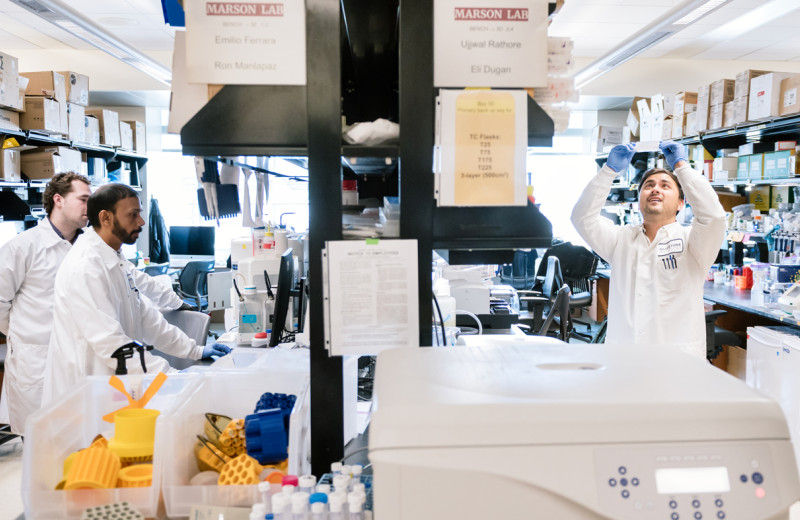
A new genetic roadmap reveals hundreds of hidden players in HIV infection, including two proteins that stop HIV in its tracks.
News Release Research (Publication) HIV/AIDS Genomic Immunology Krogan Lab Marson LabScience in Seconds | A New Path Toward Life Without Daily HIV Pills
Video
March 20, 2026
Science in Seconds | A New Path Toward Life Without Daily HIV Pills
In this video, Nadia Roan and Ashley George explain how they uncovered a new path toward long-term health without the need for daily HIV pills.
Gladstone Experts Research (Publication) HIV/AIDS Infectious Disease Roan Lab