Gladstone NOW: The Campaign Join Us on the Journey✕





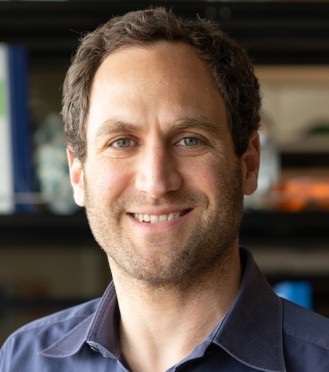
Using a new screening platform they developed, scientists at Gladstone and UCSF—including Julia Carnevale (left) and Qi Liu (right)—uncovered gene edits that enhance CAR-T cells’ ability to infiltrate and eliminate solid tumors.
Listen to this article
For patients with blood cancers like leukemia and lymphoma, the immunotherapy known as CAR-T cell therapy can be lifesaving. Doctors remove a patient’s immune cells, called T cells, engineer them in the lab to better recognize and attack cancer, and infuse them back into their bloodstream. But for solid tumors—which include lung, pancreatic, ovarian, colon, breast, and other cancer types—these engineered immune cells still meet too much resistance to effectively treat the disease.
Now, scientists at Gladstone Institutes and UC San Francisco (UCSF) discovered a pair of genetic edits that make CAR-T cells more effective at infiltrating and fighting solid tumors. In mice, T cells with these edits dramatically outperformed standard CAR-T cells, clearing tumors in many cases where unedited CAR-T cells had little or no effect.
The discovery, published in Nature, was made using the world’s first in vivo genome-wide CRISPR screen in human T cells. Developed by the same team, this platform enabled them to study the effect of gene edits on CAR-T cells inside living mice across the entire genome, rather than only in isolated cell cultures in a dish.
“We were able to identify therapeutic targets that would likely have been missed in conventional cell culture systems, bringing us closer to therapies that can truly work against solid tumors.”
“We started to realize that a lot of the work in lab dishes wasn’t modeling what T cells have to contend with in a living organism,” says Gladstone Affiliate Investigator Julia Carnevale, MD, senior author of the new study. “For years, the field has lacked a way to perform genome-scale genetic screens directly in human T cells within living tumors. By developing a screening platform that overcomes this challenge, we were able to identify therapeutic targets that would likely have been missed in conventional cell culture systems, bringing us closer to therapies that can truly work against solid tumors.”
“We now have a way to run these screens across the entire genome inside a living animal, and that changes what we can discover,” says Alex Marson, MD, PhD, director of the Gladstone-UCSF Institute of Genomic Immunology, a co-author of the study. “This is the kind of platform that will keep generating answers for the field, beyond what we’ve already done here. We think it fundamentally expands what’s possible for developing the next generation of cell therapies.”
A New Screening System
For several years, scientists including Marson and Carnevale have been using CRISPR gene editing to make thousands of different edits to T cells and screen which make the cells more powerful at fighting cancers. But previous approaches had tested the T cells in lab dishes.
Running screens in the complex, hostile environment of a real tumor had long seemed out of reach, mostly because so few T cells survived in the vicinity of a solid tumor, making it hard to draw statistically relevant conclusions about what genes helped or hurt survival.
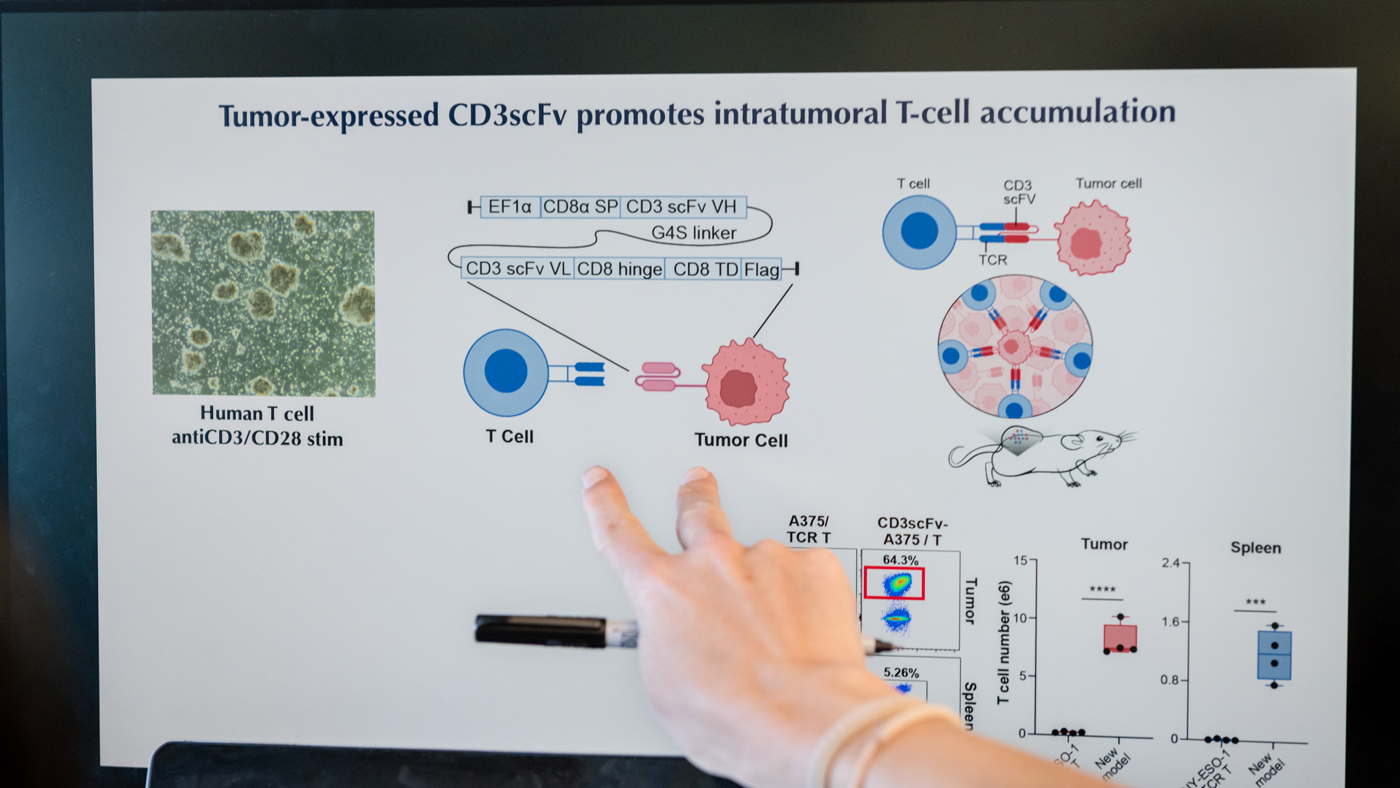
Qi Liu, PhD, a postdoctoral researcher co-mentored by Carnevale and Marson, tried a new approach. She engineered tumor cells to display a signal that attracts T cells, causing them to accumulate in the tumors.

Carnevale (left), Liu (right), and their colleagues screened nearly 20,000 genes and found two that are especially important for fighting cancer.
The T cells still struggled to kill cancer cells, but they survived long enough to be recovered from the tumor environment and studied. With previous methods, researchers had only been able to recover tens-to-hundreds of thousands of T cells from a tumor. With the new technique, Liu and Carnevale could recover many millions of T cells from each tumor, making these new screens CRISPR screens possible.
“As soon as we started treating these engineered tumors in mice with human T cells, we were seeing five to ten million cells come back out of each tumor,” says Liu, first author of the study. “That completely changed what was possible. It was the moment we realized that we had finally overcome a longstanding technical bottleneck, opening the door to testing every gene in the genome at once, inside a living animal.”
A Powerful Pair of Genes
With that system in place, the group ran two complementary screens using healthy human T cells that had been altered by CRISPR to switch off one of nearly every gene in the human genome. The first looked for edits that allowed T cells better accumulate in tumors in mice. The second focused on the T cells that did get in, to see which edits helped them stay more active and produce more of a key “cancer fighting” signal called interferon-gamma.
Among nearly 20,000 genes tested in the screens, two genes emerged as especially important.
T cells lacking a gene called P2RY8 flooded into tumors in greater numbers than normal. The results suggested that tumors usually produce a molecule that activates P2RY8 in nearby immune cells, putting the brakes on the T cells’ ability to move into the tumor. Without that gene, that brake was gone.
Once inside tumors, T cells lacking a gene called GNAS produced higher levels of interferon-gamma than other T cells. The researchers found that GNAS acts as a central hub for processing signals that aim to suppress both solid tumor cells and other cells within the tumor microenvironment. Removing GNAS made T cells far less responsive to those signals, allowing them to maintain their tumor-fighting activity.
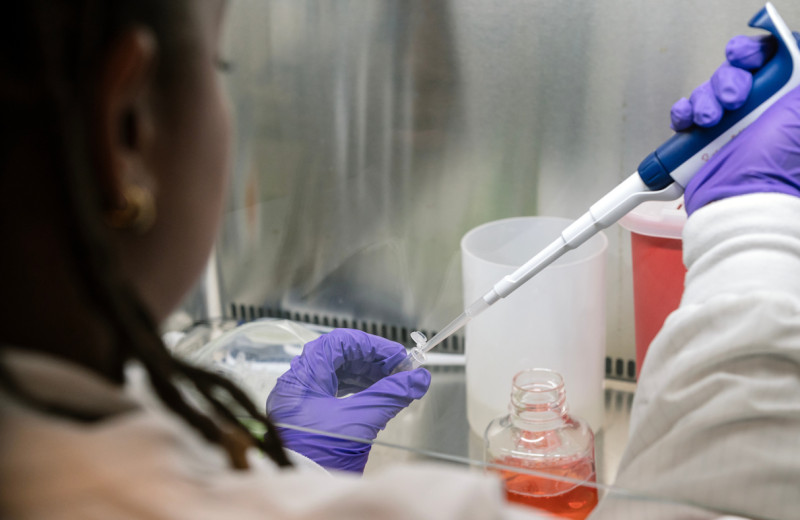
The new screening platform developed by the team can be used to explore more questions about T cell biology that have previously been difficult to study in living animals.
“Tumors throw a lot of different suppressive signals at T cells, and normally each one acts like its own off switch,” Liu says. “What we found is that many of those off switches run through one shared circuit, and disabling GNAS let the T cells stop listening to all of them at once.”
The scientists found that CAR-T cells lacking GNAS shrank tumors across multiple mouse models of solid cancer, including melanoma, lung cancer, pancreatic cancer, gastroesophageal adenocarcinoma, and uterine sarcoma.
Removing both GNAS and P2RY8 together produced an even greater benefit. Even at a very low CAR-T cell dose, two-thirds of mice in a lung cancer model were tumor-free at the study’s end, compared with none who received control-edited T cells.
Importantly, the findings also translated to patient-derived T cells. When the researchers repeated the experiments using T cells from human patients with ovarian cancer and melanoma patients, the gene edits still enabled the T cells to fight tumors.
More Discoveries Ahead
The new CAR-T cell edits will require additional testing before they can be moved to human clinical trials. However, the initial results suggest a favorable safety profile; the researchers tracked mice for more than six months after their tumors cleared and saw no long-term side effects. The scientists suspect the safety will persist, since the edits to the T cells don’t broadly activate them throughout the body.
“When you look at these edited cells outside of the tumor, they look the same as normal T cells,” says Carnevale, who is also an assistant professor of hematology and oncology in the Department of Medicine at UCSF. “The differences only become apparent within the tumor microenvironment, which is exactly the kind of edit you want.”
In addition to continuing to study the GNAS and P2RY8 edits, the team plans to keep using their new screening platform to explore more questions about T cell biology. The same approach can be applied to different tumor types or genetic perturbations, as well as other aspects of T-cell function that have previously been difficult to study at genome scale in living animals.
“We think this opens the door to a whole new generation of discoveries for cell therapy, well beyond the two genes we describe in this paper,” Carnevale says. “We’re just beginning to see what this platform can reveal.”
For Media
Julie Langelier
Associate Director, Communications
415.734.5000
Email
About the Study
The paper, “In vivo genome-wide CRISPR screens of human T cells in solid tumors,” was published in the journal Nature on August 12, 2026. In addition to Carnevale, Marson, and Liu, authors are Peixin Amy Chen, Esha Urs, Shimin Zhang, Maya M. Arce, Charlotte H. Wang, Jun Yan, Zhongmei Li, Jin Seo, Nupura Kale, Yikai Luo, Laine Goudy, Chandrima Modak, Emma Dann, Jae Hyung Jung, Brian R. Shy, Justin Eyquem, and Stacie E. Dodgson of the Gladstone-UCSF Institute of Genomic Immunology; Taylor N. LaFlam, Fanglue Peng, Haixia Zhong, Sagar P. Bapat, Greg M. Allen, Katherine Fuh, and Jason G. Cyster of UCSF; Amanda Kirane, Allison Betof Warner, Boi Bryant Quach, and Zinaida Good of Stanford; and Eric Shifrut of Tel Aviv University.
The work was supported by the National Institutes of Health, the Parker Institute for Cancer Immunotherapy, CRISPR Cures for Cancer, the Mark Foundation for Cancer Research, the Pascarella Scholars fund, the Burroughs Wellcome Fund, the Lydia Preisler Shorenstein Donor Advised Fund, the UCSF Living Therapeutics Initiative, the Weill Cancer Hub West, the Outstanding Doctoral Graduates Development Scholarship of Shanghai Jiao Tong University, the Simons Foundation, the Cancer Research Institute, the Innovative Genomics Institute, the Larry L. Hillblom Foundation (2020-D-002-NET), Arc Institute, the Byers family, and K. Jordan.
About Gladstone Institutes
Gladstone Institutes is an independent, nonprofit life science research organization that uses visionary science and technology to overcome disease. Established in 1979, it is located in the epicenter of biomedical and technological innovation, in the Mission Bay neighborhood of San Francisco. Gladstone has created a research model that disrupts how science is done, funds big ideas, and attracts the brightest minds.

Gladstone NOW: The Campaign
Join Us On The Journey
How a Single Viral Protein Hijacks Immune Cells to Supercharge COVID-19 Infection
Article
September 18, 2026
How a Single Viral Protein Hijacks Immune Cells to Supercharge COVID-19 Infection
A new discovery reveals how a SARS-CoV-2 protein reprograms immune cells to accelerate viral spread—and points to a new strategy for therapeutic intervention.
News Release Ott Lab COVID-19 Infectious DiseaseThe 2026 Ogawa-Yamanaka Stem Cell Prize Awarded to Jun Takahashi

Article
September 14, 2026
The 2026 Ogawa-Yamanaka Stem Cell Prize Awarded to Jun Takahashi
Takahashi is recognized for his pioneering work translating iPS cell technology into a clinically approved therapy for Parkinson’s disease.
Ogawa Stem Cell Prize Stem Cells/iPSCs Regenerative Medicine News Release AwardsScientists Decode Gene Circuits of Human Immunity, Fueling New Era of Disease Research

Article
August 28, 2026
Scientists Decode Gene Circuits of Human Immunity, Fueling New Era of Disease Research
An unprecedented map of 22 million immune cells provides the functional rulebook for virtual biology and next-generation immunotherapies.
Marson Lab Genomic Immunology Cancer Autoimmune Diseases News Release