Gladstone NOW: The Campaign Join Us on the Journey✕




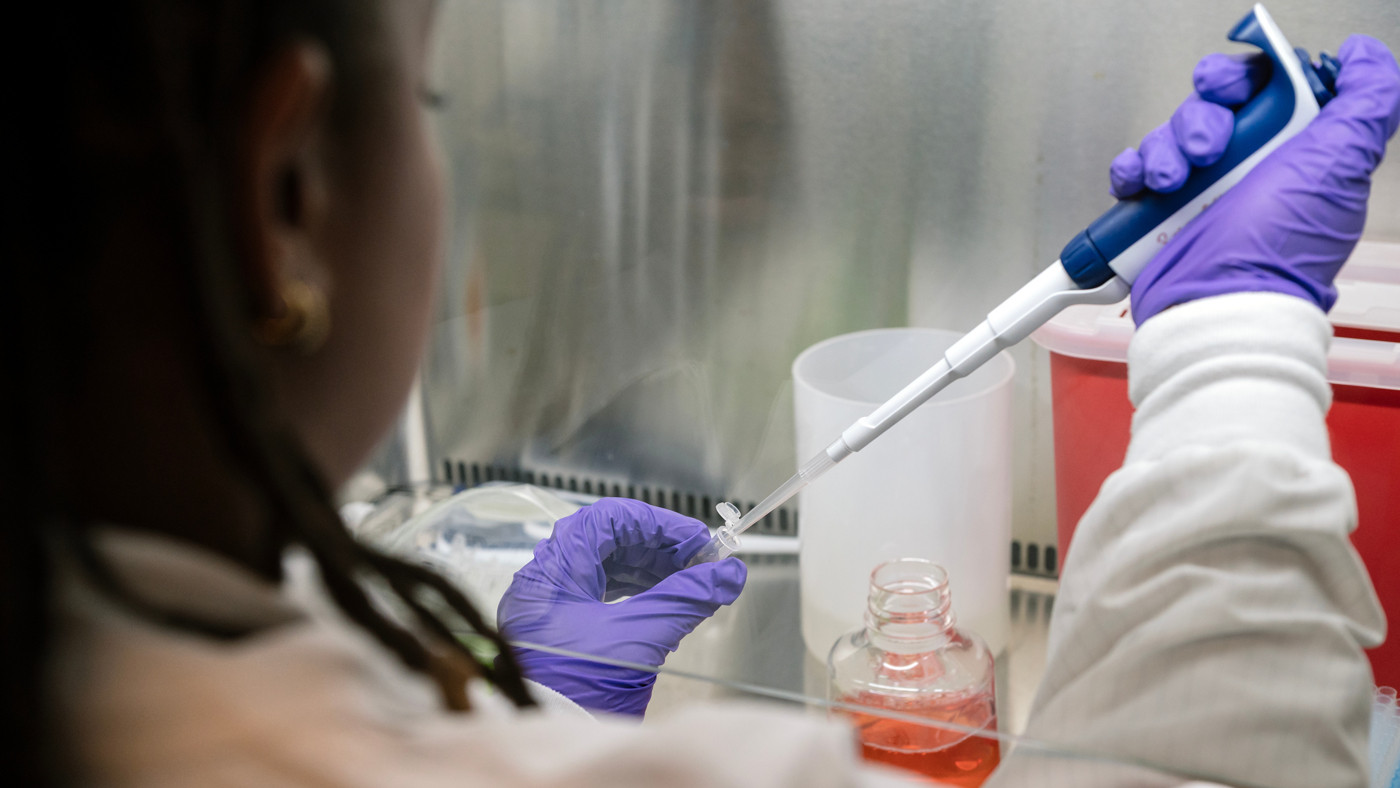
A team of scientists at Gladstone Institutes and UC San Francisco discovered how a SARS-CoV-2 protein reprograms immune cells to accelerate viral spread, pointing to a new strategy for therapeutic intervention.
In the sickest COVID-19 patients, the SARS-CoV-2 virus doesn’t just cause severe damage by directly infecting airway cells. The virus can also trigger hyperinflammation—a cycle in which the immune cells themselves become infected, stop fighting the virus, and instead trigger high levels of inflammation throughout the lungs.
Now, researchers at Gladstone Institutes and UC San Francisco (UCSF) have discovered how a SARS-CoV-2 protein called ORF8 is responsible for hijacking the immune system’s macrophages and causing this dangerous cycle. The work, published in Science Advances, also shows that blocking ORF8 reduces lung inflammation and damage in mice infected with SARS-CoV-2.
“Our results reveal that ORF8 is really a key ringleader behind how SARS-CoV-2 spreads and causes severe lung inflammation,” says Melanie Ott, MD, PhD, the Nick and Sue Hellmann Distinguished Professor and director of the Gladstone Infectious Disease Institute. “By showing how this protein tricks our immune cells, we’ve uncovered a promising new path for developing treatments to protect the lungs.”

Ott and her team have been searching for vulnerabilities in the SARS-CoV-2 virus that could be exploited with drugs, and focused on the viral protein ORF8 for this new study.
Setting Off a Cellular Chain Reaction
At the height of the COVID-19 pandemic in 2020, Gladstone and UCSF researchers teamed up to map out the interactions between SARS-CoV-2 proteins and human proteins. Their goal was to find vulnerabilities in the virus that could be exploited with drugs.
Among many other findings, the study flagged the small protein ORF8—made by SARS-CoV-2—as binding to a human immune receptor called IL-17RA. Subsequent research found contradictory evidence about the role of the protein in disease: in isolated lung cells, ORF8 seemed to put a brake on viral replication, but variants of SARS-CoV-2 that didn’t have the ORF8 protein tended to cause milder disease.
The new research focused on the effect of ORF8 on macrophages, which are immune cells known to play an active role in how the body responds to COVID-19. Ott’s team found that when macrophages are exposed to ORF8, they begin producing more copies of ACE2, the receptor that SARS-CoV-2 uses to enter cells. With more ACE2 on their surfaces, these macrophages become easier for the virus to infect. ORF8, it turns out, acts as a key to infect macrophages—not lung cells.
Further experiments showed macrophages that were exposed to ORF8 and became infected with SARS-CoV-2 were more likely to lose their ability to fight the virus and eventually die, releasing an inflammatory signaling molecule as they did so. This signaling molecule, in turn, caused widespread inflammation and made lung cells more susceptible to infection.

Matsui and his colleagues found the SARS-CoV-2 virus doesn't simply evade the immune system, it hijacks immune cells to fuel infection and lung damage.
“We were surprised to see how effectively ORF8 turns our own immune defenses against us,” says Yusuke Matsui, MD, PhD, staff research scientist in Ott’s lab and first author of the new study. “ORF8 is hijacking macrophages to enhance infection of the surrounding tissue.”
Indeed, when the researchers added macrophages to lung cells, they saw the virus carrying ORF8 replicated far more efficiently than the virus without it. And, mice infected with the ORF8 virus showed more lung damage and scarring than those infected with the virus that lacked the protein.
A New Target for Severe Infections
For clinicians, one of the most challenging aspects of treating severe COVID-19 is the balancing act between calming the immune system—to prevent hyperinflammation—and preserving the immune system’s ability to fight off the virus. They often turn to steroids, which can turn down inflammation but prevent the body from eliminating SARS-CoV-2.
The new findings point toward a more targeted way to treat hyperinflammation. Blocking the interaction between ORF8 and IL-17RA stops the cycle of macrophage infection, death, and inflammation that is at the root of this problem.
“By showing that this single viral protein is the main bridge between viral growth and tissue damage, we’ve found a clear target for new treatments.”
To this end, Ott and her colleagues tested brodalumab, an antibody that blocks IL-17RA and is already FDA-approved to treat the skin condition psoriasis. In mice infected with the virus carrying ORF8, a similar anti-IL17RA antibody decreased inflammation, virus levels, and lung scarring. More work is needed to see whether this could be beneficial in humans with severe COVID-19.
“This study answers a fundamental question about how SARS-CoV-2 triggers such overwhelming lung inflammation,” Ott says. “By showing that this single viral protein is the main bridge between viral growth and tissue damage, we’ve found a clear target for new treatments. Blocking this pathway could give us a powerful way to calm lung inflammation and protect patients against future viral strains.”
For Media
Julie Langelier
Associate Director, Communications
415.734.5000
Email
About the Study
The paper, “Secreted ORF8 reprograms macrophages to enhance SARS-CoV-2 infection of lung epithelial cells,” was published in the journal Science Advances on September 28, 2026. Authors include: Yusuke Matsui, Mauricio Montano, Taha Y. Taha, Mir M. Khalid, Limeng Sun, Kanika Khanna, Jin Tang, Yuan Zhou, Robyn M. Kaake, Nevan J. Krogan, and Melanie Ott of Gladstone Institutes; Xiaohui Fang, Mazharul Maishan, and Michael A. Matthay of UCSF; and Rahul K. Suryawanshi of the National Institute of Allergy and Infectious Diseases (NIAID) Rocky Mountain Laboratories.
The work was supported by the National Institutes of Health (U19AI135990, U54HL147127), the James B. Pendleton Charitable Trust, the Hellman Foundation, Biohub, P. and E. Taft, the Gordon and Betty Moore Foundation, the California HIV/AIDS Research Program (H24BD7838S), and the Intramural Research Program of the NIH.
About Gladstone Institutes
Gladstone Institutes is an independent, nonprofit life science research organization that uses visionary science and technology to overcome disease. Established in 1979, it is located in the epicenter of biomedical and technological innovation, in the Mission Bay neighborhood of San Francisco. Gladstone has created a research model that disrupts how science is done, funds big ideas, and attracts the brightest minds.
Gladstone NOW: The Campaign
Join Us On The Journey
The 2026 Ogawa-Yamanaka Stem Cell Prize Awarded to Jun Takahashi
Article
September 14, 2026
The 2026 Ogawa-Yamanaka Stem Cell Prize Awarded to Jun Takahashi
Takahashi is recognized for his pioneering work translating iPS cell technology into a clinically approved therapy for Parkinson’s disease.
Ogawa Stem Cell Prize Stem Cells/iPSCs Regenerative Medicine News Release AwardsScientists Decode Gene Circuits of Human Immunity, Fueling New Era of Disease Research

Article
August 28, 2026
Scientists Decode Gene Circuits of Human Immunity, Fueling New Era of Disease Research
An unprecedented map of 22 million immune cells provides the functional rulebook for virtual biology and next-generation immunotherapies.
Marson Lab Genomic Immunology Cancer Autoimmune Diseases News ReleaseNew Toolkit Turns Macrophages Into Better Cancer Fighters
Article
August 17, 2026
New Toolkit Turns Macrophages Into Better Cancer Fighters
Gladstone and UCSF scientists developed a method to genetically edit myeloid cells, immune cells that act as the body’s first responders.
News Release Marson Lab Carnevale Lab Cancer Genomic Immunology CRISPR/Gene Editing