Meet Gladstone: Sarp Dora Kurtoglu
Research associate Sarp Dora Kurtoglu uses AI and gene editing in the Theodoris Lab to search for new ways to stop aortic aneurysms, driven by the patients he hopes his work will one day help.
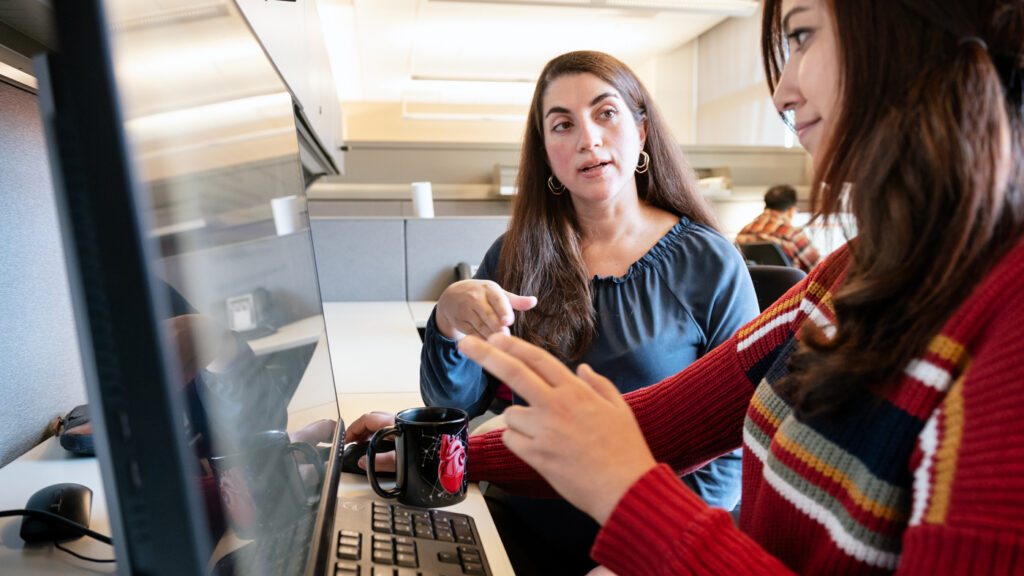
Sarp Dora Kurtoglu is a research associate in the lab of Christina Theodoris, MD, PhD, at Gladstone Institutes, where he applies AI models to patient datasets to uncover new ways to treat cardiovascular disease. Kurtoglu is a UC Berkeley graduate with a degree in bioengineering and a concentration in computational biology. Now, working at the cutting edge of science at Gladstone, he is preparing for medical school with the goal of turning discoveries made in the lab into real benefits for patients.
What brought you to Gladstone?
I graduated from UC Berkeley with a degree in bioengineering. I also concentrated in computational biology. During my undergraduate degree, I was working with Guo Huang, PhD, at the UCSF Cardiovascular Research Institute on cardiomyocyte regeneration. I wanted to continue studying cardiovascular biology and further develop my computational skills. The Theodoris Lab felt like the perfect place for that since here, we approach biological problems in a very multidisciplinary way.
What do you like about working at Gladstone?
I love many things about it, but most importantly, I love how what everyone is working on is so cutting-edge and innovative. Here, I feel encouraged to take risks and try things outside the box. The science and scientists I’m exposed to every day at Gladstone inspire me to keep going, take risks, and contribute to the advancement of human health.
What are the key areas of research you’re focused on?
I focus on understanding the biological mechanisms underlying cardiovascular diseases. Specifically, I’m working on understanding the biology of aortic aneurysms, which is when the vessel walls in the heart are weakened and the aorta can dilate and rupture. I’m trying to find gene targets that can stop the progression of this disease or reverse it.
For this, I’m applying AI models to large patient datasets to predict which genes may be relevant to the disease biology. I then validate these predictions in cultured human aortic cells using gene editing technologies.
How do you collaborate with other researchers, both within Gladstone and externally?
I collaborate with a lot of other labs inside and outside of Gladstone for my research projects, including the Alexanian and Tcheandijeu labs here at Gladstone, and Fischbein, and Cheng labs from Stanford. We design intricate computational analyses to enable more disease-relevant predictions, plan experiments, and share rare biological resources such as cell lines derived from patients.
The possibility that our work may one day help patients is my main motivation when I face a setback.
Sarp Dora Kurtoglu
Can you provide an example of a successful collaboration that led to significant findings or advancements?
We recently developed MaxToki, a machine learning model that can predict cell states and how they change over time. My colleague Rajiv, a postdoctoral scholar in the Alexanian Lab, and I applied this to understand cardiac aging in fibroblasts and cardiomyocytes, two types of cells found in the heart. We worked together to combine our expertise in studying these cell types in various assays and test the genes that our AI model predicted to drive aging in these cells. We efficiently conducted experiments that identified genes that, if we decrease their levels, can lead to a younger state, or if we increase their levels, can lead to an older state.
How does interdisciplinary collaboration enhance the quality and impact of your research?
In the Theodoris Lab, we have both computational and experimental scientists—those who work with data on a computer, and those who run experiments in a traditional lab setting. The combination of the two is really powerful and efficient in understanding disease. With the computational models and analyses, we can generate and test hypotheses on a very large scale. This not only saves us time in finding therapeutic targets for diseases, but it also guides us to design the best experiments in the lab to test that biology and observe the trends in a real model. Interdisciplinary research can open new frontiers that were not possible before.
What drives you in your research, especially when facing challenges or setbacks?
As a pre-medical student, I had many clinical experiences interacting with patients while volunteering or shadowing physicians. I met many patients who are suffering from the same diseases that we’re working on here. The possibility that our work may one day help these patients is my main motivation when I face a setback.
Who or what has been your biggest influence in your scientific career?
Christina Theodoris, for showing me how to approach problems from different disciplines. She showed me how to combine my computational and experimental skills to design research projects and pursue important scientific questions.
What do you do when you’re not working?
I’m either cooking my grandmother’s recipes, watching movies, or watching soccer. I also love exploring San Francisco.
What is your hidden talent?
I really enjoy photography. I bought my first camera 5 years ago. I mainly focus on nature and street photography.
What advice would you give to young scientists or students interested in your field?
Be patient. Every step and failure is progress, even if it doesn’t feel like it in the moment.
Up Next
Christina Theodoris to Receive ASCI’s 2026 Seldin-Smith Award for Pioneering Research
The prestigious honor is presented by the American Society for Clinical Investigation to a physician-scientist making transformative contributions to biomedical research.
Ask a Scientist: Can We Turn Off the Molecular Switches That Cause Heart Failure?
Michael Alexanian is studying two promising genetic avenues for addressing heart failure, a massive global health burden in need of innovative treatments.
Gladstone Scientists Are Awarded $2 Million to Map How HIV Affects the Immune System
By uniting the power of single-cell sequencing, organoids, and artificial intelligence, scientists are entering a new era of HIV research.
Christina Theodoris Honored in Inaugural Cohort of Young American Scientists
Scientific American recognizes Theodoris for her pioneering work developing artificial intelligence models to find treatments for an array of diseases.

Get Involved
Join the Team
Our people are our most important asset. We offer a wide array of career opportunities both in our administrative offices and in our labs.
Open PositionsPartner With Us
Discoveries don’t stay in our labs. Gladstone facilitates spinout companies to advance promising therapies, shortening the path between scientific discovery and helping real patients.
Learn MoreGive
Your gift to Gladstone will allow our researchers to pursue high-quality science, focus on disease, and train the next generation of scientific thought leaders.
Donate Now