Gladstone NOW: The Campaign Join Us on the Journey✕




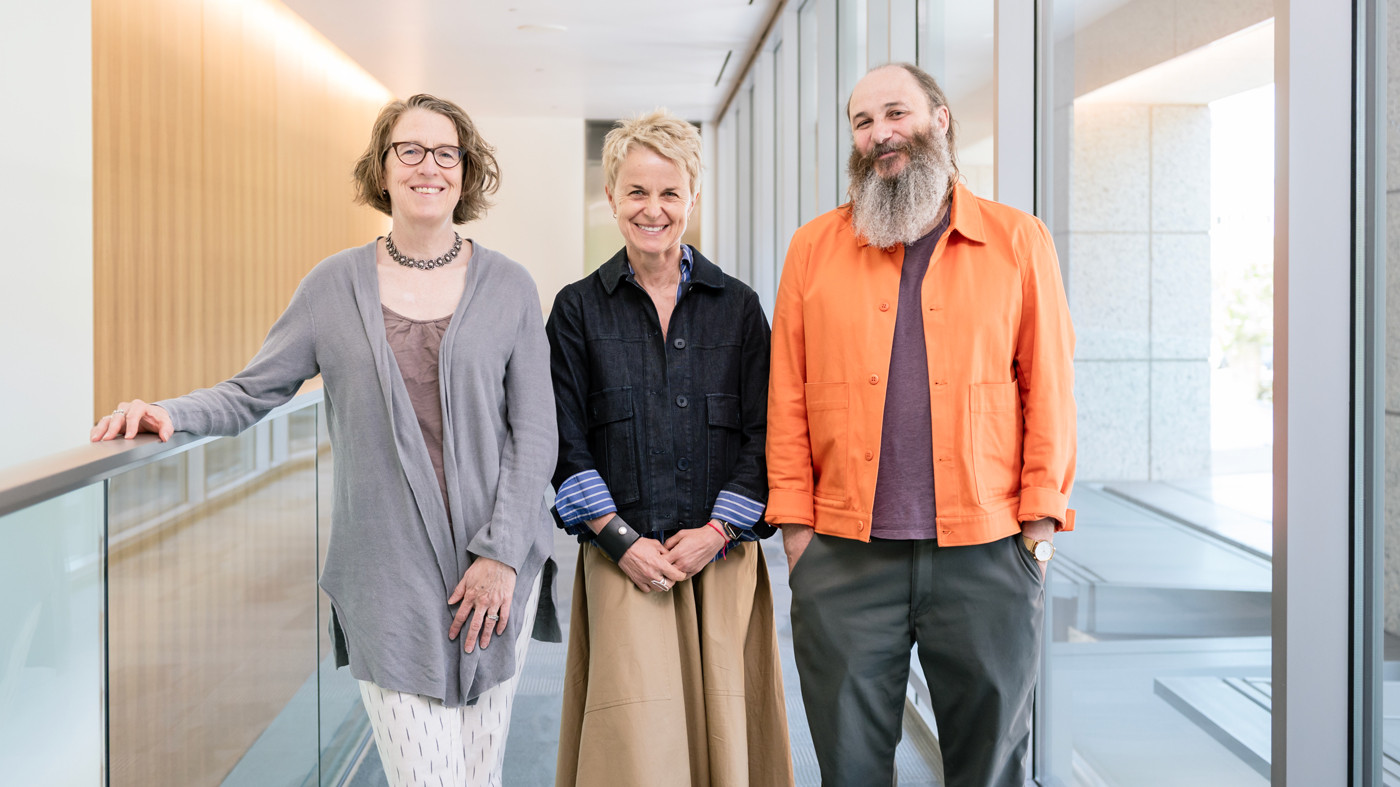
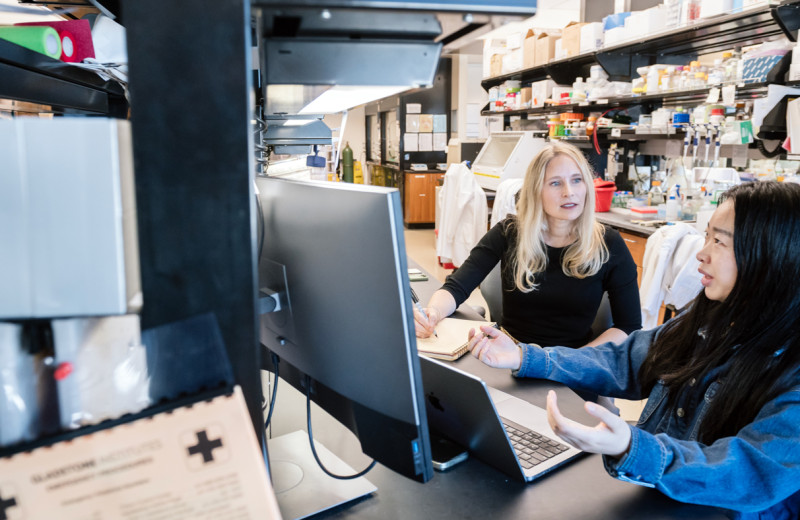
A team of Gladstone scientists—including Katie Pollard (left), Melanie Ott (center), Seth Shipman (right), and Sukrit Silas (absent from the photo)—will lead one of three new national centers dedicated to accelerating the development of phage therapy.
Listen to this article
When a bacterial infection stops responding to antibiotics, doctors have few options to treat it. Phages—viruses that naturally infect and kill bacteria—have long intrigued clinicians as a potential weapon against these infections. But translating these tiny bacteria hunters into drugs has been slow and unreliable.
Now a new effort, powered by engineering and artificial intelligence, could change that.
Gladstone Institutes has received an initial award of $2 million from the National Institute of Allergy and Infectious Diseases (NIAID), with additional funding of up to a total of $10 million available over the proposed 5-year project period. This grant will establish the Center for PhAIge Therapy, a research center that will develop new phage-based treatments for antibiotic-resistant bacterial infections.

Pollard (left), Ott (center), and Shipman (right) are part of the new Center for PhAIge Therapy at Gladstone focused on building the preclinical tools and models needed to make phages a more reliable treatment for infections.
The five-year grant makes Gladstone one of three institutions across the country selected to lead this coordinated effort. Together, the new Centers for Accelerating Phage Therapy to Combat ESKAPE Pathogens (CAPT-CEP) will advance the therapeutic use of phages.
The Center for PhAIge Therapy will be directed by Gladstone Investigator Seth Shipman, PhD, with projects and core components led by an interdisciplinary team of other Gladstone scientists.
“Phages have the potential to treat drug-resistant infections, but for patients to benefit from that potential, we need to be able to predict which phage to use for which patient, and design phages that are more effective than what we have today,” says Shipman. “That’s what this center is designed to do.”
Tackling Critical Threats to Modern Medicine
Every year, about 5 million deaths around the world are associated with antibiotic-resistant infections.
People with weakened immune systems, including those with cancer who are receiving immune therapies, are particularly vulnerable because they rely heavily on effective antibiotics. But antibiotic resistance is no longer confined to high-risk patients—it’s increasingly affecting the broader hospital population as well.
Among the leading causes of these deaths are major hospital “superbugs” called the ESKAPE pathogens—Enterococcus faecium, Staphylococcus aureus, Klebsiella pneumoniae, Acinetobacter baumannii, Pseudomonas aeruginosa, and Enterobacter species.
These bacterial species appear on the World Health Organization’s list of priority pathogens. They are considered critical threats to modern medicine not only because they resist drugs, but they swap defense mechanisms and quickly adapt after being exposed to new antibiotics.
“We’re not just studying phages using the same methods as in the past; we’re making an infrastructure to rationally predict how we can use phages with success in the future.”
Given that phages have evolved the ability to kill bacteria in distinct and targeted ways, they have attracted growing interest as a potential weapon against ESKAPE pathogens and other antibiotic-resistant infections.
So far, despite promising results in individual patients, phage therapy has remained difficult to use at a larger scale, in part because it has required so much trial and error for each patient.
The new Center for PhAIge Therapy will build the preclinical tools and models needed to overcome this obstacle and make phages a more reliable treatment for infections.
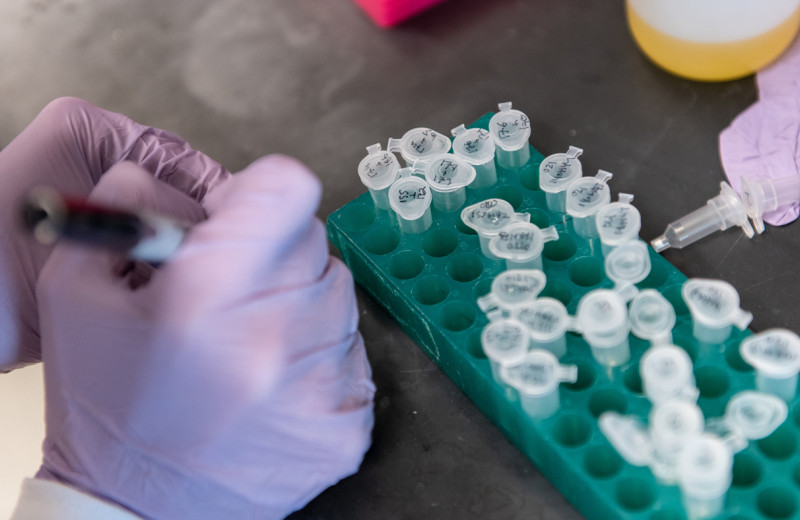
Gladstone scientists have developed AI tools to predict which phages can work against a particular strain of bacteria, but the models are lacking the right data to make the predictions accurate. So, the researchers will run massive experiments using engineered phages and bacteria to better understand, step by step, how bacteria are killed.
“The goal of our center is to generate an unprecedented amount of data and train AI models to identify the right phage for any patient’s infection,” says Shipman.
Deploying Phages Against Drug-Resistant Pathogens
Shipman’s lab has already developed tools to precisely edit phage genomes in a highly effective way, giving them the ability to engineer new phages.
The Center for PhAIge Therapy will allow the team to build on that technology and develop new tools to accelerate research on how best to optimize and deploy phages against ESKAPE pathogens.
They will build high-throughput assays to measure how individual parts of phages contribute to their activity against bacteria. The project will ultimately generate the data needed to rationally design and select phages effective against Klebsiella pneumoniae.
In healthcare settings, Klebsiella pneumoniae can cause serious infections—including pneumonia, bloodstream infections, and meningitis—among patients on ventilators or intravenous catheters. These bacteria are becoming increasingly resistant to antibiotics, even the last lines of defense used against bacterial infections, and drive over 600,000 deaths per year.
In parallel to Shipman’s work, Gladstone Investigator Sukrit Silas, PhD, will characterize how Klebsiella pneumoniae strains vary in their susceptibility to phages, with the goal of identifying phage combinations most likely to work against specific strains.
Powering both projects will be close collaborations with Katie Pollard, PhD, director of the Gladstone Institute of Data Science and Biotechnology, and Melanie Ott, MD, PhD, director of the Gladstone Infectious Disease Institute.

Pollard (left) and Shipman (right) are joining forces with their colleagues to generate an unprecedented amount of data about phages and train AI models that will identify phage-based treatments for antibiotic-resistant bacterial infections.
Pollard will lead the development of new algorithms to predict the compatibility of phage-bacteria pairs and to optimize natural phages into drugs. Using human lung organoids that more closely mimic human tissues than traditional animal models, Ott’s team will study how the body’s environment impacts phage behavior and treatment outcomes, something that can’t be captured in conventional laboratory models.
“What excites me about this collection of projects is that we’re creating a system where the data and the AI build off each other with each iteration,” says Shipman. “We’re not just studying phages using the same methods as in the past; we’re making an infrastructure to rationally predict how we can use phages with success in the future.”
In addition to the Gladstone Center for PhAIge Therapy, the CAPT-CEP network will also be supporting the Center for Phage Pharmaceuticals at Stanford University, which will focus on phage delivery to the lung, and the Pitt Center for Accelerating Phage Therapy at the University of Pittsburgh, which will develop assays for designing and dosing phage cocktails for patients. The three centers will share assays, materials, and data.
For Media
Julie Langelier
Associate Director, Communications
415.734.5000
Email
About Gladstone Institutes
Gladstone Institutes is an independent, nonprofit life science research organization that uses visionary science and technology to overcome disease. Established in 1979, it is located in the epicenter of biomedical and technological innovation, in the Mission Bay neighborhood of San Francisco. Gladstone has created a research model that disrupts how science is done, funds big ideas, and attracts the brightest minds.
About the Grant
The Center for PhAIge Therapy at Gladstone will receive $10,239,795 over five years from the National Institute of Allergy and Infectious Diseases (NIAID), as part of the Centers for Accelerating Phage (Bacteriophage) Therapy to Combat ESKAPE Pathogens (CAPT-CEP). The grant P01AI195327 was awarded as a result of the funding call RFA-AI-24-069.


Gladstone NOW: The Campaign
Join Us On The Journey
Scientists Decode Gene Circuits of Human Immunity, Fueling New Era of Disease Research

Article
August 28, 2026
Scientists Decode Gene Circuits of Human Immunity, Fueling New Era of Disease Research
An unprecedented map of 22 million immune cells provides the functional rulebook for virtual biology and next-generation immunotherapies.
Marson Lab Genomic Immunology Cancer Autoimmune Diseases News ReleaseNew Toolkit Turns Macrophages Into Better Cancer Fighters
Article
August 17, 2026
New Toolkit Turns Macrophages Into Better Cancer Fighters
Gladstone and UCSF scientists developed a method to genetically edit myeloid cells, immune cells that act as the body’s first responders.
News Release Marson Lab Carnevale Lab Cancer Genomic Immunology CRISPR/Gene EditingNew CRISPR Screening Platform Boosts Power of Immunotherapy Against Solid Tumors
Article
August 12, 2026
New CRISPR Screening Platform Boosts Power of Immunotherapy Against Solid Tumors
A new screening platform uncovers gene edits that enhance CAR-T cells’ ability to infiltrate and eliminate solid tumors.
News Release Carnevale Lab Cancer Genomic Immunology CRISPR/Gene Editing