Gladstone NOW: The Campaign Join Us on the Journey✕




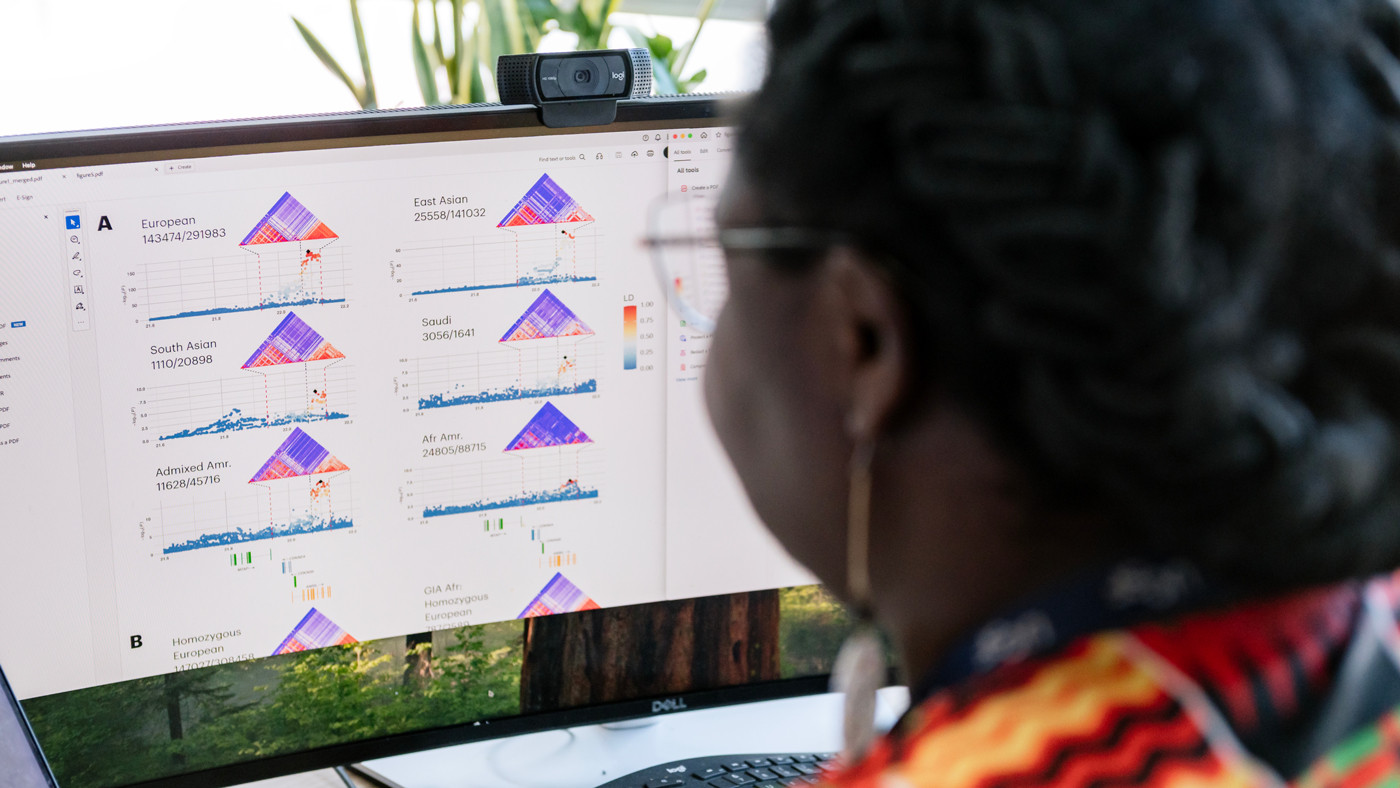
For decades, a DNA-based test for cardiovascular disease seemed to work for Europeans and others but not Africans. Gladstone scientists just discovered why, with implications for many other diseases.
Listen to this article
Around 20 years ago, scientists uncovered a major clue in human DNA: on chromosome 9, a specific region known as “9p21” predicts whether someone is at risk for the most common form of heart disease. However, the breakthrough came with a catch. While the warning signal was easy to spot in people with European descent and other groups, it barely registered in people of African descent. How could that be?
This was a troubling puzzle for Catherine Tcheandjieu, DVM, PhD, an investigator at Gladstone Institutes who began studying 9p21 as a postdoctoral researcher. What made this DNA region for Africans different?
Now, after years of searching, Tcheandjieu’s Gladstone team and an international group of collaborators finally have an answer. They found that not just one, but many genetic variants in the 9p21 region likely contribute to heart disease risk.
“We’ve been wondering for a long time why 9p21 has such a strong tie to cardiovascular disease in Europeans, but not in Africans,” says Tcheandjieu, senior author of the study, which appears in American Journal of Human Genetics. “Now we understand that it was the combination of multiple risk variants that matters, and those combinations differ dramatically in African descent groups.”

Tcheandjieu and her team found that in people of African descent, the same heart risk variants exist, but they are scattered more independently across the chromosome.
In most populations around the world, the genetic variants tend to be inherited as a package; they sit close together on the same stretch of DNA and are passed down together from parent to child, generation after generation. As a result, a person who carries one of these variants usually carries most or all of them, amplifying their combined effect on risk.
In people of African descent, however, the picture looks very different. The same variants exist, but they are scattered more independently across the chromosome. This means that any one person of African ancestry is unlikely to inherit the full set of variants together. Because the variants are spread apart rather than bundled, their individual effects on heart disease risk are smaller and harder to detect, which helps explain why the 9p21 region has appeared to have a weaker link to heart disease in African-descent populations compared with other groups.
Same Risk Variants, Different Layout
Quite often, DNA is organized so that large segments called haplotypes are preserved from generation to generation. As researchers study these segments, they find certain genes and DNA variations cluster together and are inherited in blocks. This serves as useful shorthand for scientists, as they can study relatively large blocks of linked gene variants.
This is exactly what’s happening on 9p21. In populations of European descent, these heart risk variants are inherited together in large groupings, like a cluster of brightly colored beads on a bracelet. If you spot one bead, you know the rest are there.
But because human life began in Africa, those populations have been around much longer than others. They have a broad array of many different haplotypes, each with varying numbers of risk and protective variants. Because non-African groups derive from migrations of relatively few individuals from Africa, their tableau of haplotypes of risk variants is much more restricted. In this case, the risk and protective variants aggregate on essentially only two haplotypes, one with high overall risk and the other with low overall risk.
“The same risk variants are there in all populations, but in some cases, they’re sitting on different haplotypes, creating these really complex associations,” says Hasan Alkhairo, PhD, a postdoctoral scholar in Tcheandjieu’s lab and first author of the new study. “The risk variants are still present, but the signal isn’t nearly as strong in the African groups.”
Notably, the scientists also found that people of East Asian descent have their own unique risk haplotype. Thus, one-size-fits-all approaches of identifying risk may need to be reappraised, they say.

The team's research, published in the American Journal for Human Genetics, likely will impact how genetic risk of cardiovascular disease and other conditions are detected in the future.
Health Equity’s at Stake
This study could have a ripple effect on how genetic risk of cardiovascular disease and other conditions are detected. For example, cardiovascular genetic risk tests based on data derived primarily from European ancestry populations may not generalize well to other non-European ancestry groups.
The researchers also concluded the phenomenon observed with 9p21 is unlikely to occur just at this chromosome location or for heart disease; it likely also explains other genetic differences among ancestral populations for other diseases in other location in the genome.
The study’s findings also may influence how scientists approach genome-wide association studies—a method commonly used to scan entire genomes of thousands or millions of people to find specific genetic variants tied to disease or other traits. The new research underscores the need to review how these studies are interpreted, which can lead to better health equity across globally diverse populations.
“The latest diagnostics trend is to build polygenic risk scores that show who has the greatest risk of developing a specific disease,” says Neil Risch, PhD, a population geneticist who founded the Institute for Human Genetics at UC San Francisco, and a co-senior author of the study. “These scores could be quite helpful, but not if they’re undercounting certain populations. Our research helps explain the disparities we’ve been seeing in these scores, and will hopefully help create more accurate measures of disease vulnerability.”
A Big-Data Discovery
Tcheandjieu and her colleagues used a big data approach to reveal the hidden 9p21 risk in African populations.

Using state-of-the-art genomics and machine learning technology, Tcheandjieu aims to define the genes associated with cardiovascular diseases in diverse human populations.
First, they tested thousands of DNA samples from different population around the world. This included samples from the Veterans Affairs’ Million Veteran Program, the UK Biobank, the Biobank Japan, the Africa Wits-INDEPTH partnership for Genomic studies, and other sources. From there, they used multiple sophisticated statistical approaches, including a method called “hamming distance,” which helped them determine how different variants were scrambled in the genome of different groups.
“Right now, when we use genetic scores to predict almost any disease, they’re often significantly less accurate for people of African ancestry—especially if the tool was built using data from European patients,” says Tcheandjieu, who is also assistant professor in the Department of Epidemiology and Biostatistics at UCSF. “The way this heart signal gets diluted in African descent groups proves that we cannot use a one-size-fits-all approach to detect disease-linked variants. We have to be incredibly careful and embrace new methods to calculate a person’s true medical risk.”
For Media
Kelly Quigley
Director, Science Communications and Media Relations
415.734.2690
Email
About the Study
The study, “Linkage Disequilibrium and Allelic Heterogeneity Explain Variation in Coronary Artery Disease Risk at 9p21 Across Populations and Reduced Effect in Africans,” appeared on July 1, 2026 in the American Journal of Human Genetics.
Authors include Hasan Alkhairo, Satoshi Koyama, Kruthika Iyer, Austin T. Hilliard, Pik Fang Kho, Shoa Clarke, Firdous M. Abdulwahab, Themistocles L. Assimes, Julie A. Lynch, Michèle Ramsay, Human Heredity and Health in Africa (H3Africa), VA Million Veteran Program (MVP), Kyong Mi Chang, Philip S. Tsao, Fowzan S. Alkuraya, Kaoru Ito, Neil Risch, and Catherine Tcheandjieu.
About Gladstone Institutes
Gladstone Institutes is an independent, nonprofit life science research organization that uses visionary science and technology to overcome disease. Established in 1979, it is located in the epicenter of biomedical and technological innovation, in the Mission Bay neighborhood of San Francisco. Gladstone has created a research model that disrupts how science is done, funds big ideas, and attracts the brightest minds.
Ask a Scientist: Can We Turn Off the Molecular Switches That Cause Heart Failure?

Article
August 25, 2026
Ask a Scientist: Can We Turn Off the Molecular Switches That Cause Heart Failure?
Michael Alexanian is studying two promising genetic avenues for addressing heart failure, a massive global health burden in need of innovative treatments.
Alexanian Lab Cardiovascular Disease Human Genetics Grants Congenital Heart DiseaseHow an Alzheimer’s Risk Gene Disrupts Brain Circuits Long Before Memory Loss
Article
April 3, 2026
How an Alzheimer’s Risk Gene Disrupts Brain Circuits Long Before Memory Loss
New findings on the APOE4 gene variant point to a potential therapeutic target for Alzheimer’s disease.
News Release Research (Publication) Alzheimer’s Disease Neurological Disease Huang Lab Aging Human GeneticsScience in Seconds | Researchers Pinpoint Key Gene Behind Heart Defects in Down Syndrome

Video
November 3, 2025
Science in Seconds | Researchers Pinpoint Key Gene Behind Heart Defects in Down Syndrome
In this video, Gladstone scientists share how they used stem cells, gene editing, and AI to identify a gene driving heart defects in Down syndrome—and how reducing its levels in mice restored normal heart development, offering hope for future treatments
Gladstone Experts Cardiovascular Disease Data Science and Biotechnology Pollard Lab Srivastava Lab AI Big Data CRISPR/Gene Editing Human Genetics Stem Cells/iPSCs