Novel Biosensor Uses DNA ‘Barcodes’ to Uncover Disease Signals in Cells
Inspired by bacterial biology, the Gladstone-developed “Detectron” opens up new possibilities for disease research and potentially treatments.
Listen:
Inside every cell, RNA acts as a vital messenger. Its levels rise when genes are active, while specific fragments can serve as clear warning signs of a viral infection.
Reading these cellular messages gives scientists a direct window into human health, but finding and measuring specific RNA strands inside a cell is often a cumbersome, multi-step process.
To simplify it, researchers at Gladstone Institutes have built a customizable biosensor called the “Detectron.” With mechanics borrowed from retrons, an ancient defense mechanism found in bacteria, the Detectron functions like a smart tripwire: the moment it senses a target RNA strand, it responds by churning out distinct, easy-to-read DNA “barcodes.”
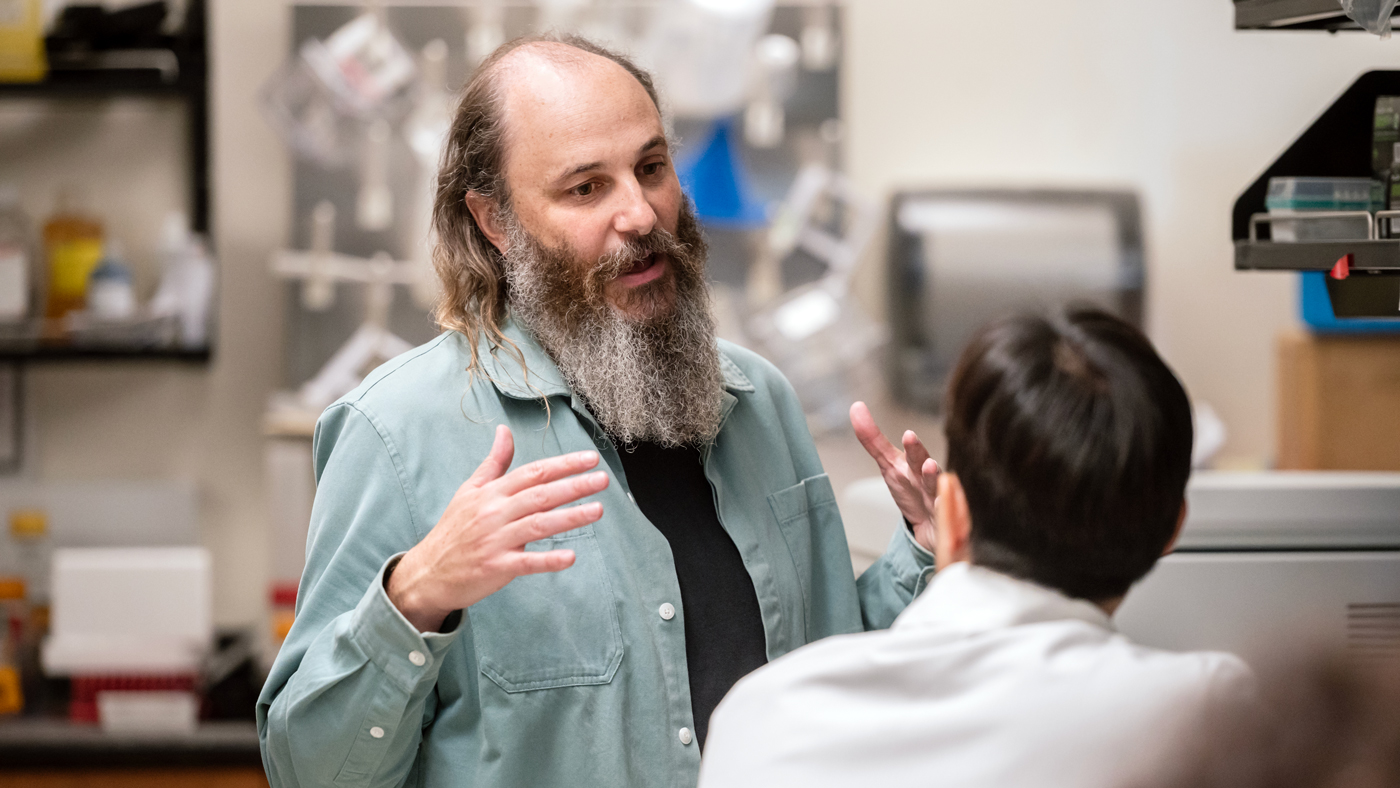
“To build Detectrons, we combined the DNA-production machinery of retrons with a molecular switch that can be programmed to detect pretty much any RNA sequence,” says Gladstone Investigator Seth Shipman, PhD, senior author of the new study published in the journal Nature Biotechnology. “It gives us a completely new lens for studying biology. And down the line, it could even be used to trigger targeted interventions or treatments in cells.”
Combining the Best of Two Worlds
Detectrons are the latest in a suite of retron-derived tools developed in Shipman’s lab. The tools repurpose retrons’ ability to produce small strands of DNA inside cells—a key step in their traditional role as antiviral agents in bacteria.
“We like retrons because they’re essentially easy-to-use, adaptable DNA barcode generators,” Shipman says. “Our tools work by ensuring the DNA is only made in response to something we choose.”
What sets Detectrons apart from prior retron tools is they have been designed to directly detect RNA itself, something that had not been accomplished until now.
To create Detectrons, Shipman’s group turned to a synthetic biology tool known as a toehold switch—a hairpin-shaped molecule that only opens up if it directly binds to the RNA sequence it is programmed to detect. Typically, opening the hairpin is like flipping on the switch because it unblocks production of a pre-specified color of fluorescent protein, alerting that the RNA was sensed.
“With standard toehold switches, you run out of different possible colors very quickly, so you can only look for a few different RNA sequences at once,” says Jihoon Han, PhD, a postdoctoral researcher in Shipman’s lab and lead author of the study. “In contrast, DNA barcodes can have any possible sequence, so you could theoretically have billions in play simultaneously, each reporting on a unique RNA sequence.”
We’re excited to make our own discoveries with Detectrons, but we also really want to make them useful to other researchers so they can design their own versions.
Seth Shipman, PhD
The researchers set out to combine the best of both worlds: the direct-detection capabilities of a toehold switch with the versatility of retrons’ DNA barcodes—and the Detectron was born.
A Detectron’s molecular switch starts out in the “off” position. Only if an RNA fragment with a particular targeted sequence binds to it, the switch will turn on and prompt the Detectron to begin pumping out small pieces of DNA. The DNA fragments have a known, preprogrammed sequence, which acts as a barcode that can be read back by standard sequencing, revealing the presence of the target RNA.
“We can combine different Detectrons in the same cell at once, each programmed to detect a unique RNA sequence and make a corresponding barcode,” Han says. “That means we can look for multiple RNA targets at the same time, which opens up so many opportunities for discovery.”
Speeding Disease Research with Detectrons
To demonstrate how Detectrons could be applied in disease research, Shipman and Han chose to focus on phage therapy—the use of bacteria-attacking viruses, or phages, to treat bacterial infections.
Phage therapy holds promise as a potential weapon against bacteria that have become resistant to conventional antibiotics, and scientists around the world are studying which types of phages are best suited for it. But typically, narrowing down promising phages for a therapy takes a very long time, as each type must be tested one by one in a dish to see how well it kills a given bacterial strain.
To streamline this process, Gladstone’s team designed several different Detectrons, each programmed to detect RNA from a different phage of interest. They inserted each Detectron into a separate population of E. coli bacteria, and mixed the Detectron-carrying bacteria together in a single tube. The mixture was then exposed to one phage type at a time to determine whether the corresponding DNA barcode was produced.
“We found that, by looking at which DNA barcodes were produced in higher amounts, we could identify which phage had successfully infected the bacteria,” Han says. “This and similar experiments show how Detectrons could be used to help quickly narrow down the right phage for attacking an antibiotic-resistant superbug.”
But potential applications for Detectrons extend far beyond this example.
“When gene editing is used to treat disease, there may be cases where the gene-editing machinery is delivered to unintended cells that should not be edited,” Han says. “With Detectrons, the RNA-triggered switch could give us an extra layer of control, which we could theoretically use to ensure the editing machinery only turns on inside intended cells, while staying off in all other cells.”
Detectrons for All
Shipman’s group is now exploring how to best design Detectrons for use in human cells, which are very different molecular environments from bacterial cells. They are also investigating how to enable Detectrons to reliably sense much longer RNA fragments—up to hundreds of times longer—than the fragments in this study.
All of the lab’s Detectron schematics and programming code are available for use by other laboratories.
“We’re excited to make our own discoveries with Detectrons, but we also really want to make them useful to other researchers so they can design their own versions,” Shipman says. “We want Detectrons to work as well in their hands as they do in ours.”
For Media
About the Study
The study, “Detectrons convert transient RNA sequences into stable DNA barcodes for high-throughput analysis of RNA-dependent processes,” appears in Nature Biotechnology. Authors are Jihoon Han and Seth L. Shipman.
The work was supported by the Bachrach Family Foundation and the Robert J. Kleberg, Jr. and Helen C. Kleberg Foundation.
About Gladstone
Gladstone Institutes is an independent, nonprofit life science research organization that uses visionary science and technology to overcome disease. Established in 1979, it is located in the epicenter of biomedical and technological innovation, in the Mission Bay neighborhood of San Francisco. Gladstone has created a research model that disrupts how science is done, funds big ideas, and attracts the brightest minds.
Up Next
Gladstone’s Seth Shipman Named Fellow of the California Academy of Sciences
Shipman is recognized for pioneering molecular technologies that record cellular activity, expand genome editing, and target antibiotic-resistant superbugs.
Gladstone Launches Center for PhAIge Therapy to Harness AI in the Fight Against Drug-Resistant Infections
The center, funded by an NIH grant, will become one of three national centers dedicated to accelerating the development of phage therapy.
A Universal Toolkit for Editing Bacterial DNA
Scientists at Gladstone expanded their retron-based genome editing technology beyond E. coli, showing it works in 15 diverse bacterial species.
How AI Is Pinpointing the Genetic Cause of Disease
Scientists at Gladstone are combining AI models with cutting-edge lab tools to finally make sense of the human genome.

Get Involved
Join the Team
Our people are our most important asset. We offer a wide array of career opportunities both in our administrative offices and in our labs.
Open PositionsPartner With Us
Discoveries don’t stay in our labs. Gladstone facilitates spinout companies to advance promising therapies, shortening the path between scientific discovery and helping real patients.
Learn MoreGive
Your gift to Gladstone will allow our researchers to pursue high-quality science, focus on disease, and train the next generation of scientific thought leaders.
Donate Now