Gladstone NOW: The Campaign Join Us on the Journey✕





Kevin Pastores helps researchers turn complex cellular data into scientific discoveries.
From studying HIV and vaccine development to helping scientists unlock insights from complex datasets, Kevin Pastores has built his career around advancing biomedical research. As assistant core director of Gladstone’s Flow Cytometry Core, he oversees daily operations, trains researchers on specialized instruments, and helps design experiments and analyze data.
Before joining Gladstone, Pastores focused on engineering SHIVs—hybrid Simian-Human Immunodeficiency Viruses—to improve animal models used to evaluate HIV therapeutics. Today, he combines that scientific expertise with a passion for supporting researchers across disciplines, helping them make the most of the powerful technologies available in the core.
What brought you to Gladstone?
I originally joined a virology lab at Gladstone, but since then, I’ve transitioned to management of the Flow Cytometry Core serving as the assistant core director.
What do you like about Gladstone?
There are lots of things to like about Gladstone, but personally, what I like most is the commitment to career development for trainees. For example, I participated in a Scientific Leadership and Management course, in which Gladstone invited speakers to discuss the challenges of managing and building a team. Gladstone is not only training great scientists, but also cultivating excellent managers.
What is flow cytometry?
The simplest way to explain flow cytometry is that you’re taking cells and running them through a machine. As the cell passes through, the machine shoots lasers at it, and generally what happens is the cell will glow. The machine then measures how much it glows. That glow tells us something important about the cell—whether a particular molecule is there or not, or whether the cell is capable of functioning in a certain way. By looking at those signals, we can learn a lot about what’s happening inside thousands of cells very quickly.
What are you currently working on in the core?
One of the projects we’re working on in the Flow Cytometry Core is optimizing our microglia panel. By nature, microglia—immune cells in the brain—are highly autofluorescent, so if you run them through a flow cytometer, they’ll glow regardless of the dyes you use to stain them. This makes it difficult to accurately study them. Having an optimized microglia panel enables us to properly profile these cells to further develop our understanding of its important role in various neurodegenerative diseases. It’s a challenging project, but we hope to develop this panel that we can offer to researchers studying microglia within and outside of Gladstone.
How do advancements in technology impact the way you conduct your research?
Like many other fields, flow cytometry has also been impacted by the advent of artificial intelligence (AI), particularly when it comes to data analysis. A lot of the experiments that researchers design produce large data sets and it can be very challenging to sift through the results. Many companies that specialize in flow cytometry are rolling out programs to assist researchers with that process.
How do you collaborate with other researchers, both within Gladstone and externally?
Working in the Flow Cytometry Core, there are definitely lots of opportunities for collaboration. Researchers, both internal and external, come to us with the goals of their project and we assist them with executing their ideas, whether it be with experimental design, training on the instruments, or data analysis. We also collaborate with the other cores at Gladstone for some of the services we provide. For example, we have a pipeline with the Stem Cell Core where we test human induced pluripotent stem (iPS) cells for pluripotency markers.
Who has been your biggest influence in your scientific career?
I would say the biggest influence in my scientific career is a postdoc from my grad school lab. Whenever I’m asked to think about what a great mentor looks like, he immediately comes to mind. Training another person requires a lot of patience and he definitely had that.
We’re still in contact and occasionally, I seek out his advice regarding the trajectory of my career. When I was choosing between Gladstone and another research institute on the East Coast, I asked what he thought and he said, “I think you’ll like Gladstone more,” and here we are.
What do you do when you’re not working?
When I’m not tinkering with the machines in the Flow Cytometry Core, I like to be physically active, so I’m probably at the gym or running around San Francisco. If I’m not doing that, I’m probably at a café with a book chugging cold brew and eating something covered with Nutella.
What is your hidden talent?
I can sing. I can hold a note—I studied vocal performance in undergrad, and I sing in my church choir as a baritone.
What advice would you give to young scientists or students interested in your field?
A lot of fresh college grads are unsure of what field they’d like to study in grad school. Working in a core facility is a great way to immerse yourself across different fields. In my core, we assist researchers across the different institutes at Gladstone with advancing their projects. One minute we’re looking at cardiomyocytes for someone studying cardiovascular disease, and an hour later, we’re analyzing HIV-infected cells with a researcher in virology.
Want to Join the Team?
Our people are our most important asset. We offer a wide array of career opportunities both in our administrative offices and in our labs.
Explore CareersMeet Gladstone: Lexi Schneider
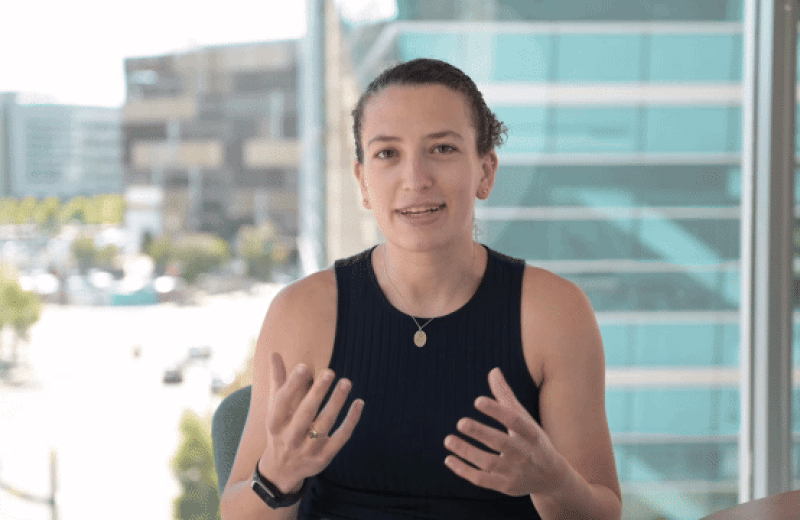
Article
August 24, 2026
Meet Gladstone: Lexi Schneider
Meet Lexi Schneider, a PhD student using innovative technology to uncover how the blood-brain barrier communicates.
Profile Graduate Students and Postdocs Yang LabAn Ancient Genetic Twist and Its Modern Impact on Brain Disease
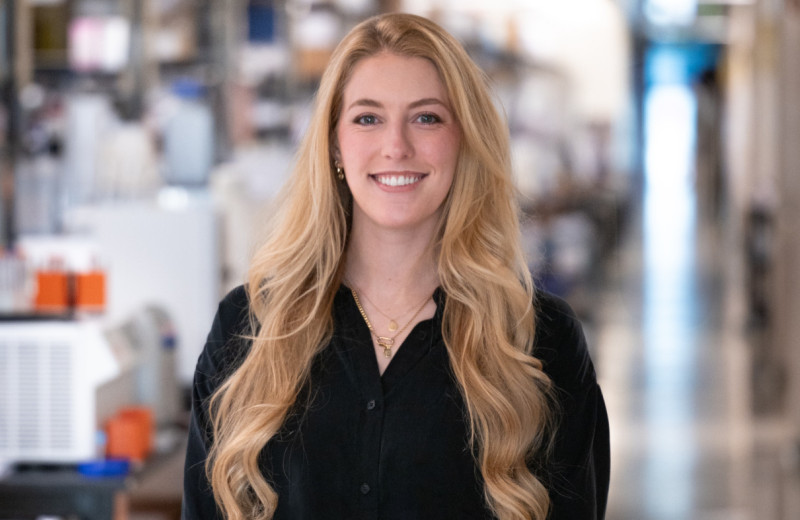
Article
July 14, 2026
An Ancient Genetic Twist and Its Modern Impact on Brain Disease
NOMIS–Gladstone Fellow Cathrine Sant is studying an enigmatic region of the human genome linked to neurodegenerative disease risk.
Neurological Disease NOMIS Graduate Students and Postdocs ProfileMeet Gladstone: Shu Zhang
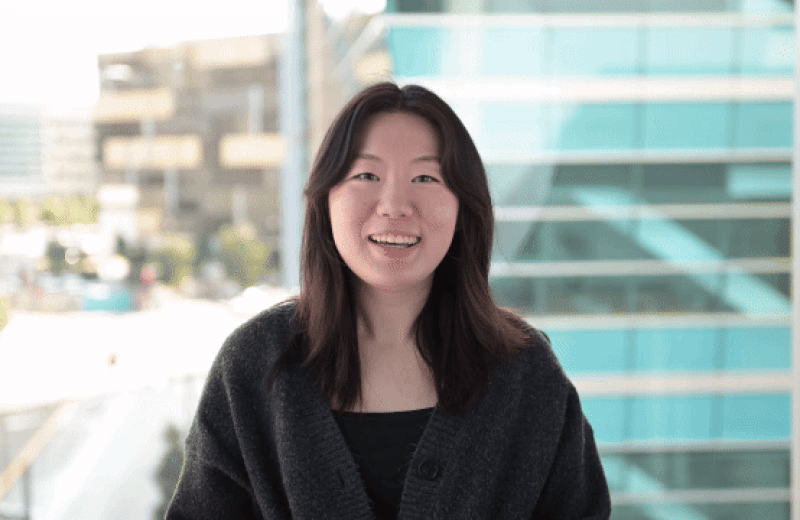
Article
April 22, 2026
Meet Gladstone: Shu Zhang
Graduate student Shu Zhang uses machine learning to reveal how DNA variation shapes genome structure and drives disease.
Postdoctoral and Graduate Student Education and Research Development Affairs Graduate Students and Postdocs Profile