



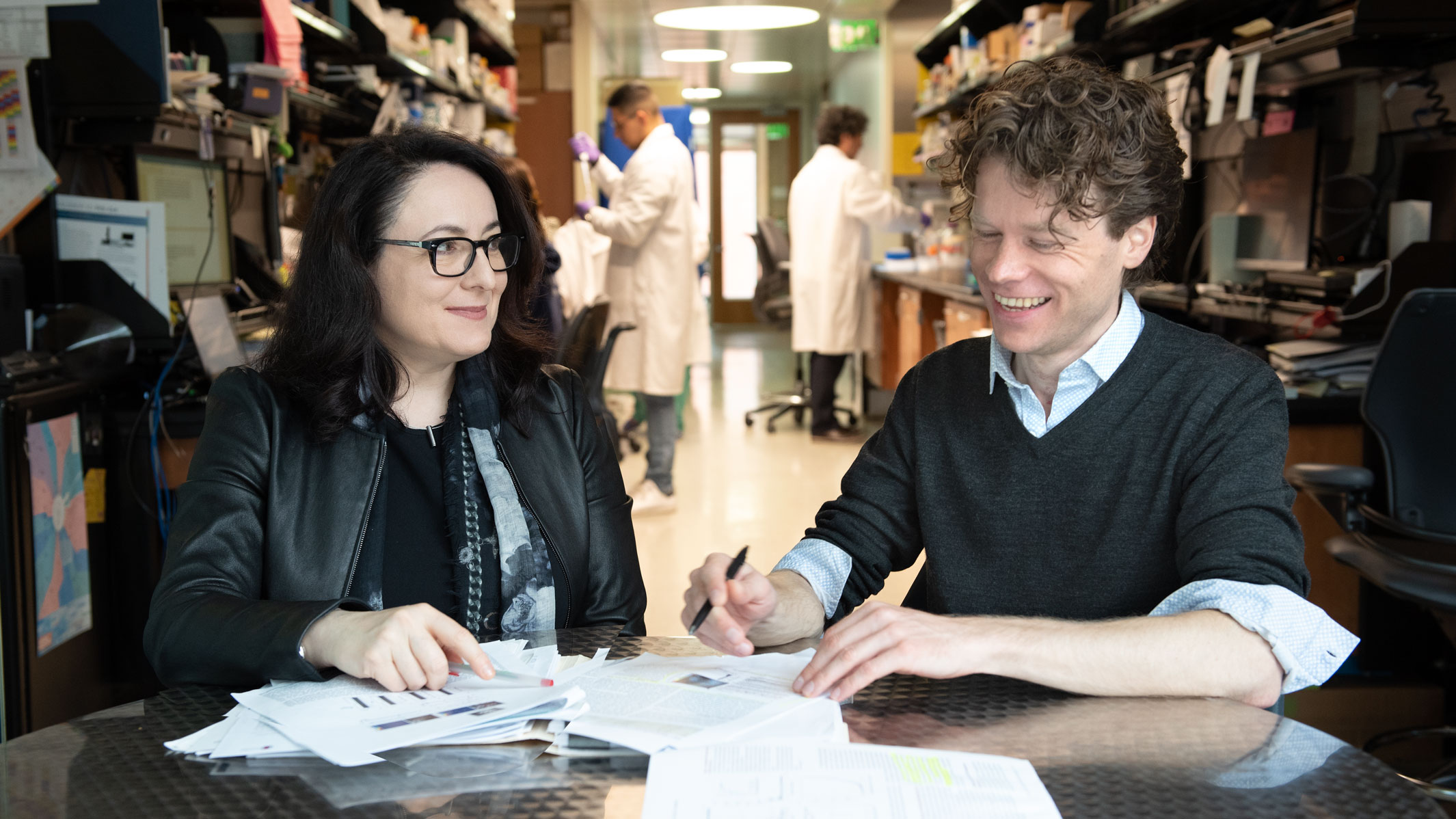
Katerina Akassoglou and her team have discovered new mechanisms that control the communication between the brain, the immune system, and the vascular system, and designed novel therapies for neurological diseases. Akassoglou’s lab pioneered studies showing that when the blood-brain barrier is disrupted, the blood-clotting factor fibrinogen can leak into the brain, where it induces neurodegeneration. Their findings indicate that fibrinogen leakage could contribute to a wide range of neurological conditions, including multiple sclerosis, Alzheimer’s disease, traumatic brain injury, and stroke.
Disease Areas
Areas of Expertise
Lab Focus
Research Impact
Work from Akassoglou’s lab has led to a new way of thinking about neurological diseases by proposing a fundamental mechanism through which cerebrovascular dysfunction impairs the brain and spinal cord. Specifically, they demonstrated that the neurovascular interface is fundamentally changed in neurological disease, resulting in increased blood-brain barrier permeability that promotes toxic brain inflammation. They identified the blood clotting factor fibrinogen as a common driver for neuroinflammation and neurodegeneration and inhibitor of neurorepair. They developed the first immunotherapy that blocks the deleterious functions of fibrin and protects from neuroinflammation and neurodegeneration in animal models of multiple sclerosis and Alzheimer’s disease. Therefore, the team’s research has broad impact on the understanding of and ability to treat multiple neurological diseases, including multiple sclerosis, stroke, epilepsy, traumatic brain injury, and spinal cord injury.
Akassoglou’s team continues to investigate the mechanisms at the neurovascular interface that promote neuroinflammation, neurodegeneration, and cognitive decline. They hope to use their discoveries to develop innovative treatments, and fluid and imaging biomarkers for devastating neurological diseases.
Professional Titles
Senior Investigator, Gladstone Institutes
Director, Gladstone-UCSF Center for Neurovascular Brain Immunology
Professor, Department of Neurology, UC San Francisco
Bio
Katerina Akassoglou is a professor of neurology at UCSF, a senior investigator at Gladstone Institutes and founder and director of the Center for Neurovascular Brain Immunology. She has pioneered studies on neurovascular mechanisms of inflammation and tissue repair, and discovered the molecular interface blood proteins utilize to interact with immune and nervous system cells—common threads driving neurologic diseases—including multiple sclerosis and Alzheimer’s disease.
Akassoglou developed a first-in-class fibrin-targeting immunotherapy for the treatment of neurological diseases, currently in phase 1b clinical trials in Alzheimer’s disease and ophthalmic diseases.
She was awarded by the White House the Presidential Early Career Award for Scientists and Engineers, the Barancik Prize for Innovation in Multiple Sclerosis Research, the Vilcek Prize in Creative Promise, and the Pharmacia-ASPET Award.
She is the scientific founder of Therini Bio and was named by the San Francisco Business Times among the 2021 Most Influential Women in Bay Area Business. Akassoglou is also a fellow of the American Academy of Neurology, the ASPET, the National Academy of Inventors, and the American Association for the Advancement of Science (AAAS).
Akassoglou started her laboratory as an assistant professor of pharmacology at the University of California, San Diego where she was promoted to associate professor with tenure. She earned a BSc degree in biology and her PhD at the Hellenic Pasteur Institute and the University of Athens, Greece, with training at the University of Vienna, Austria before performing her postdoctoral work at the Rockefeller University and New York University.
How Did You Get Your Start in Science?
“I was inspired by my biology high school teacher. She helped me get a summer internship in an immunology lab and I never looked back.”
Honors and Awards
2024 Pharmacia-ASPET Award for Experimental Therapeutics
2023 Healthcare Business Awards - Honorary Science Award
2022 American Society for Pharmacology and Experimental Therapeutics (ASPET) Elected Fellow
2022 ISFP Prize, International Society for Fibrinolysis
2022 Lifetime Fellow, American Association for the Advancement of Sciences (AAAS)
2022 ASPET-JPS Keynote Lecture at the 95th Japanese Pharmacological Society Meeting
2021 Fellow, National Academy of Inventors
2021 Rita-Levi Montalcini Neurobiology Keynote Lecture – International Society for Neuroimmunology
2021 Most Influential Women in Bay Area Business, San Francisco Business Times
2019 Barancik Prize for Innovation in Multiple Sclerosis Research, National Multiple Sclerosis Society
2019 Greek Top Women Award
2018 Fellow, American Neurological Association
2016 R35 NINDS Research Program Award
2015 The Marilyn Hilton Award for Innovation in MS Research, Conrad N. Hilton Foundation
2015 Secretary/Treasurer, Molecular Pharmacology Division, American Society for Pharmacology and Experimental Therapeutics
2009 Vilcek Prize for Creative Promise in Biomedical Research (Finalist), Vilcek Foundation
2009 Exceptional Unconventional Research Enabling Knowledge Acceleration Award EUREKA, National Institutes of Health
2008 John J. Abel Award in Pharmacology, American Society for Pharmacology and Experimental Therapeutics
2007 Presidential Early Career Award for Scientists and Engineers, The White House
2007 The Dana Award in Brain and Immunoimaging
2006 Young Investigator Award, International Fibrinogen Society
2002 Young Investigator Award, International Society for Neurochemistry
2000 Young Investigator Award, International Society for Fibrinolysis and Proteolysis
1999 Fellow, Human Frontiers Science Program
1998 Women in Neuroimmunology Award, International Society of Neuroimmunology
1998 European League Against Rheumatism
Publications
Contact
Katerina Akassoglou
Email
415.734.2512
Mike Truhill Pierce
Senior Administrative Specialist
415.734.2531
Email