Gladstone NOW: The Campaign Join Us on the Journey✕




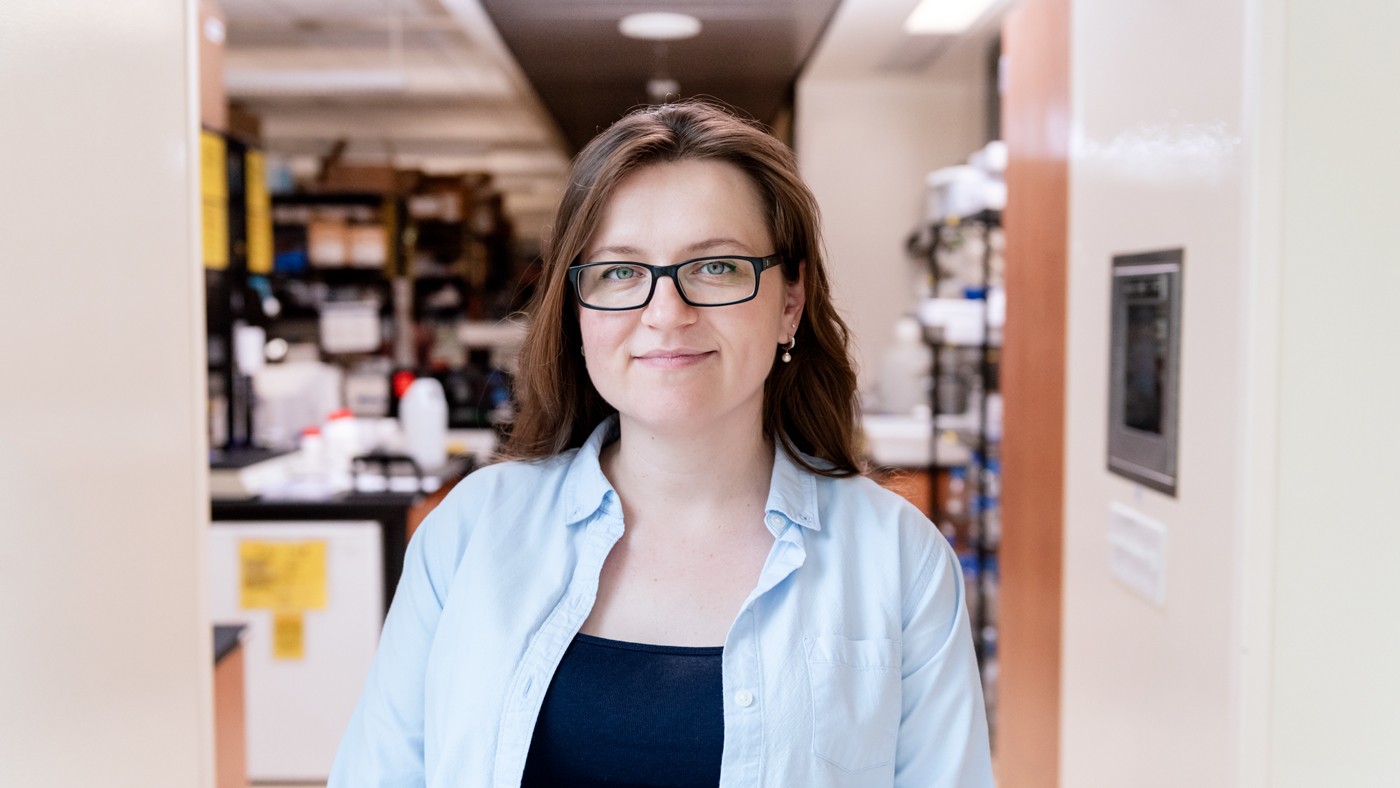
Yuliya Voskobiynyk shares her journey from Ukraine to Gladstone and how her research on microglia could shed light on brain function and diseases like epilepsy and Alzheimer’s.
When you think about the brain’s immune cells, you may envision tiny defenders fighting off infections. But in reality, microglia do much more—they help shape how the brain works and sometimes even stir up trouble. NOMIS-Gladstone Fellow Yuliya Voskobiynyk, PhD, is working to better understand the surprising roles of these brain cells, and how they might impact diseases like epilepsy and Alzheimer’s.
The NOMIS–Gladstone Fellowship is designed to support bold, cross-disciplinary research that ultimately positions fellows to launch their independent careers.
In this first-person account, Voskobiynyk shares her journey from Ukraine to Gladstone, how the NOMIS-Gladstone Fellowship supports her work, and what she hopes for the future of her research.
When I mention I study how brain immune cells talk to neurons, the response is usually a polite nod or a surprised “Wait, aren’t those just for fighting infection?” That’s the twist. In the brain, these cells don’t just fight. They listen. They whisper. They respond. And sometimes, they ignite chaos. Their conversations with neurons could help us understand the brain and its diseases, including epilepsy and Alzheimer’s.
A Journey Sparked by Curiosity and Electrical Signals
My journey into science started far from the lab—in the small Ukrainian town of Tlumach, where I was born and raised. Years later, as a neuroscience student at the University of Illinois at Chicago, I became fascinated by the brain’s electrical complexity and how tiny ion channels shape thoughts, behaviors, and consciousness.
That fascination deepened during my PhD at the University of Alabama at Birmingham in the lab of Erik Roberson, MD, PhD. There, I studied how tau and BIN1, proteins linked to Alzheimer’s disease, destabilize brain circuits. I wanted to understand why neurons go into overdrive, misfiring in patterns that disrupt memory, behavior, and awareness. But I didn’t yet have the tools to see excitability unfold in real time.
Lighting Up the Brain—Literally
This gap in my research led me to the Paz Lab at Gladstone Institutes, a world-renowned center for in vivo electrophysiology and bioengineering techniques like optogenetics. Optogenetics uses light to control neurons, helping pinpoint the role of specific cell types in the living brain. Here, I worked on mapping epileptic circuits in genetic epilepsies and finally had the tools to observe and change neuronal activity directly. I also began to recognize something else: brain immune cells, including microglia, have electrical properties, too.
Traditionally, microglia were viewed as the brain’s immune responders or cleanup crew—clearing debris, pruning synapses, and responding to injuries. But recent evidence shows that they may play more active roles in shaping how neural networks function, influencing neuronal activities and how the brain transitions from one state into another, for example, from sleep to wakefulness.
When Microglia Meet Electricity: Journey to Becoming a NOMIS–Gladstone Fellow
As a NOMIS–Gladstone Fellow, I’m exploring whether microglia can “tune in” to neuronal activity via electrical signals—not by firing action potentials like neurons do, but by responding to voltage changes around them. I am especially interested in how this happens in the thalamocortical system, the part of the brain that regulates arousal, attention, and consciousness.
What draws me in even more is the possibility that some genetic variants linked to Alzheimer’s might change how microglia behave electrically and communicate with neurons. The breakdown of neuronal-glial communication could destabilize neural networks. Could microglial missteps be among the earliest triggers of neurodegeneration, long before memory starts to disappear? That’s the question at the heart of my research.

Voskobiynyk is working to uncover how brain immune cells communicate with neurons and shed light on their role in brain disease. In this image, a mouse brain section is immunostained for microglia (blue), overlaid with a seizure trace from onset to end. Photo: Agnieszka Ciesielska and Yuliya Voskobiynyk.
For me, science is about curiosity and following unanswered questions. And right now, microglia are part of a conversation in the brain that we’re only just beginning to understand.
What makes the NOMIS–Gladstone Fellowship so special is that it gives me the freedom and support to be bold. I am fortunate to be co-mentored by professors Jeanne Paz, PhD, and Lennart Mucke, MD, two scientists who have shaped my own thinking. Paz’s pioneering work in circuit dissection and manipulation in systems neuroscience, and Mucke’s research on neuroimmune interactions in network hypersynchrony and neurodegeneration have been foundational for me. Learning from them directly while pursuing unconventional questions is a rare and valuable opportunity.
Decoding the Dialogue That Shapes the Brain
Looking ahead, I hope to lead my own research group focused on the interplay between neurons and glia, particularly how their relationships create or destabilize brain states. I believe that decoding this dialogue could lead to new ways of treating neurological conditions that we don’t fully understand.
Want to Join the Team?
Our people are our most important asset. We offer a wide array of career opportunities both in our administrative offices and in our labs.
Explore CareersMeet Gladstone: Ayush Midha
Article
September 21, 2026
Meet Gladstone: Ayush Midha
Ayush Midha, a graduate student in the Jain Lab, studies how the body's metabolism adapts to low oxygen—work that's uncovered backup energy pathways, potential fertility treatments, and a link between oxygen levels and tumor growth.
Profile Jain Lab Graduate Students and Postdocs MetabolismMeet Gladstone: Lexi Schneider
Article
August 24, 2026
Meet Gladstone: Lexi Schneider
Meet Lexi Schneider, a PhD student using innovative technology to better understand the blood brain barrier.
Profile Graduate Students and Postdocs Yang LabAn Ancient Genetic Twist and Its Modern Impact on Brain Disease
Article
July 14, 2026
An Ancient Genetic Twist and Its Modern Impact on Brain Disease
NOMIS–Gladstone Fellow Cathrine Sant is studying an enigmatic region of the human genome linked to neurodegenerative disease risk.
Neurological Disease NOMIS Graduate Students and Postdocs Profile