Gladstone NOW: The Campaign Join Us on the Journey✕




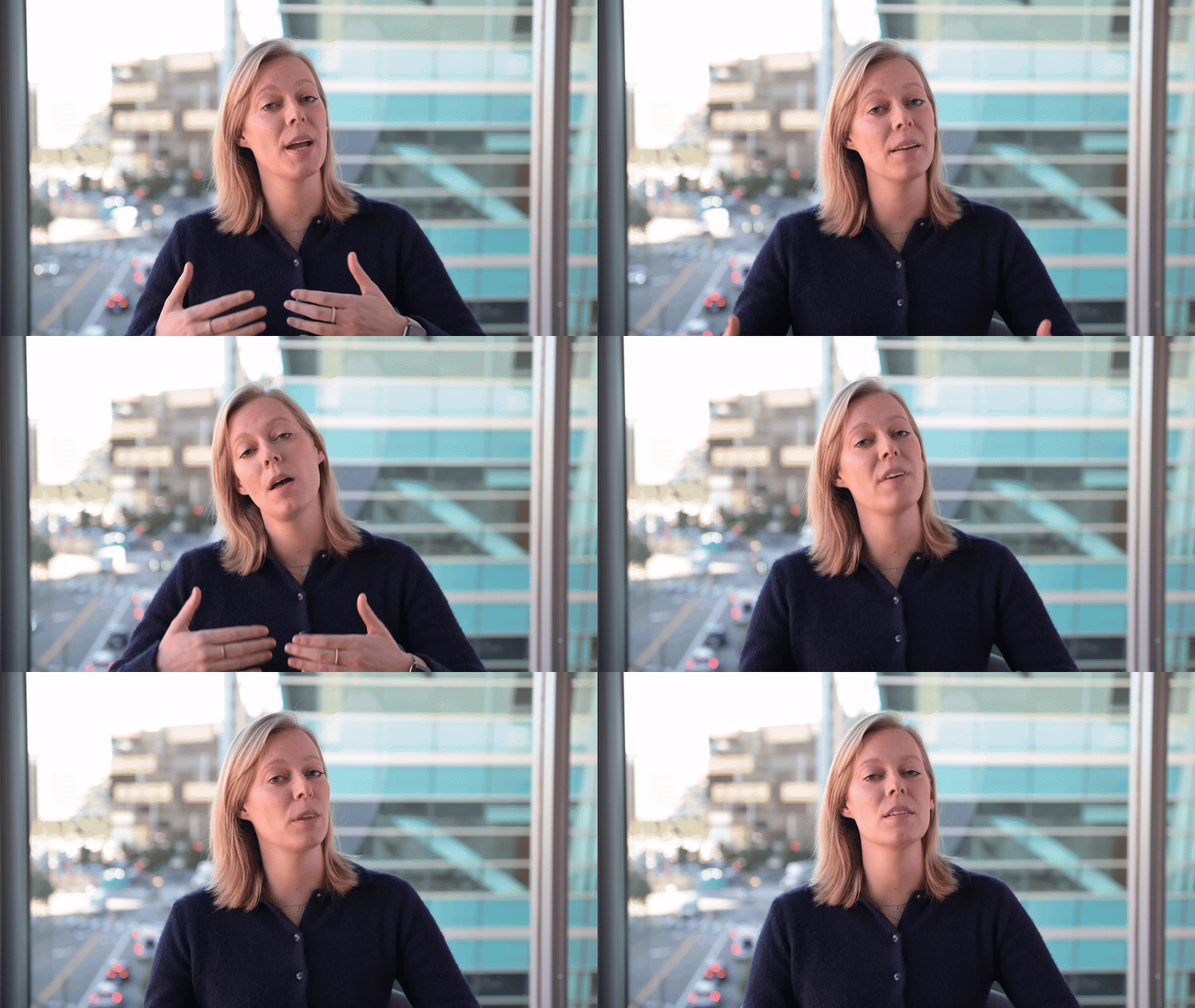
Alisa Dietl brings her international training and clinical perspective to Gladstone, where she studies how the tumor microenvironment blocks immune responses, and works to engineer more effective cancer immunotherapies for solid tumors.
Alisa Dietl’s path to science spans countries, disciplines, and a deep commitment to understanding disease. She grew up in Munich, Germany, and completed her medical training in Innsbruck, Berlin, and New York City before returning to Munich to earn her PhD in oncology. Today, Dietl brings her clinical perspective to her work as a postdoctoral researcher, where she is co-mentored by Karin Pelka and Alex Marson. Here, she focuses on how interactions between cancer and immune cells can be targeted to develop more effective cancer immunotherapies.
What brought you to Gladstone?
I was intrigued by Gladstone’s strong translational mission that bridges the gap between scientific discovery and real-world impact.
For me, the greatest motivation is the idea of not only advancing our understanding of disease, but also taking findings from the lab’s bench to the patient’s bedside by translating them into therapies that may improve patients’ lives. This is the reason I wanted to join Gladstone and be part of its goal of using science to overcome disease.
What do you like about Gladstone?
There are many things. But what I like most is Gladstone’s collaborative spirit.
To name an example, we have a group mailing list and when you run into a problem, you can send out an email asking for help or advice or even supplies like reagents—and you can count on hearing back from multiple colleagues within minutes.
Gladstone is a place where everyone is genuinely invested in each other’s success, and sharing expertise and resources happens enthusiastically. I think that is really special.
Who or what has been your biggest influence in your scientific career?
Patients in the clinic. I couldn’t help but feel frustrated by not being able to offer them a promising treatment, let alone a cure. I came to realize that I can potentially reach more patients and shape their care by doing research, and that’s why I decided to become a clinician scientist.
How does your research contribute to understanding or treating specific diseases?
Our immune system, especially killer T cells, can usually spot and destroy diseased or abnormal cells in our body. When it fails, cancer can develop.
Scientists have created a treatment called CAR T cell therapy, which reprograms the patient’s own T cells to better recognize and attack cancer cells. This works very well for some blood cancers, but hasn’t been effective against solid tumors.
That’s because solid tumors aren’t just made up of cancer cells. In fact, they are complex tissues made up of many other cells, such as stromal cells for structural support and endothelial cells that build blood vessels to feed the tumor. Together, these cells form what we call the tumor microenvironment, which acts like a fortress that builds walls and defenses to protect the cancer—and keeps killer T cells out.
In our lab, we create models that behave like real tumors. We also develop and employ new methods to map tumor tissues and their interactions with the immune system. This allows us to understand the tumor microenvironment: what it’s made of, how its cells interact, and how it blocks T cells.
Thus, by understanding the structures and signals T cells encounter, we can figure out how to protect or best arm them to overcome the hostile tumor microenvironment. We can then use these CAR T cells not only as killers, but also as tiny delivery trucks that carry drugs straight into the tumor, making treatment more effective.
How do advancements in technology impact the way you conduct your research?
Traditionally, studying tissues or cells in health and disease involved breaking them down to measure what genes or proteins were active. This method tells us what is present, but loses critical info about where the activity is happening inside the tissue. It’s like taking apart a puzzle and trying to understand the picture by looking at the loose pieces.
Large-scale spatial profiling of gene and protein expression overcomes this limitation.
It keeps the “map” of the tissue intact, so we can identify where specific cell types reside, how different cells interact, and how they shape their local environment. This information helps us understand how cancers develop and progress, why some treatments may work better in certain tissues than others, and how we can design more effective therapies.
How does interdisciplinary collaboration enhance the quality and impact of your research?
Cancer is a clever, ever-changing opponent that adapts to survive, hides from defenses, and comes in various forms.
So, I firmly believe that curing cancer can only be achieved through collective effort. No matter how brilliant you are as a researcher, each discipline is highly specialized and allows you to see only parts of the larger puzzle. But when we all come together—sharing our knowledge and resources, challenging assumptions, and building on one another’s discoveries—we unlock progress that none of us could reach alone and accelerate breakthroughs that move us closer to a future world free from cancer.
What do you do when you’re not working?
I recently got a gravel bike and I love exploring the San Francisco Bay Area with it.
My favorite thing is food—trying new restaurants, dishes, and recipes. So recently, as an incentive for longer bike rides, I plan my routes around places to stop for great food.
I also love traveling to national parks, in and outside California.
What advice would you give to young scientists or students interested in your field?
Think about what you’re truly passionate about. That might sound cliché, but what keeps you up at night? This points you toward your intrinsic curiosity and passion. These are your engines that sustain learning, creativity, out-of-the-box-thinking, and the motivation to push boundaries.
In addition to that, you will need perseverance. Science can be challenging; models and experiments fail, progress can be slow. So, you need to love what you are doing and have the resilience to keep going despite all difficulties.
Want to Join the Team?
Our people are our most important asset. We offer a wide array of career opportunities both in our administrative offices and in our labs.
Explore CareersMeet Gladstone: Lexi Schneider
Article
August 24, 2026
Meet Gladstone: Lexi Schneider
Meet Lexi Schneider, a PhD student using innovative technology to better understand the blood brain barrier.
Profile Graduate Students and Postdocs Yang LabAn Ancient Genetic Twist and Its Modern Impact on Brain Disease
Article
July 14, 2026
An Ancient Genetic Twist and Its Modern Impact on Brain Disease
NOMIS–Gladstone Fellow Cathrine Sant is studying an enigmatic region of the human genome linked to neurodegenerative disease risk.
Neurological Disease NOMIS Graduate Students and Postdocs ProfileGladstone Institutes Receives National Recognition for Excellence in Postdoc Programs
Article
July 6, 2026
Gladstone Institutes Receives National Recognition for Excellence in Postdoc Programs
Gladstone is one of only 12 institutions nationwide to receive the award for its postdoctoral programs.
News Release Postdoctoral and Graduate Student Education and Research Development Affairs Graduate Students and Postdocs Postdoc Advisory Committee Awards