Virologist Viewpoints: The Promise of Cancer Vaccines
Many people have heard of immunotherapy, a type of medical treatment that trains the immune system to recognize and destroy cancer cells. But fewer know about cancer vaccines, which essentially have the same goal.
For years, the scientific and medical communities have poured efforts into developing therapeutic cancer vaccines, and they’re now beginning to reach cancer patients. But what are they exactly? And how do they work in the body?
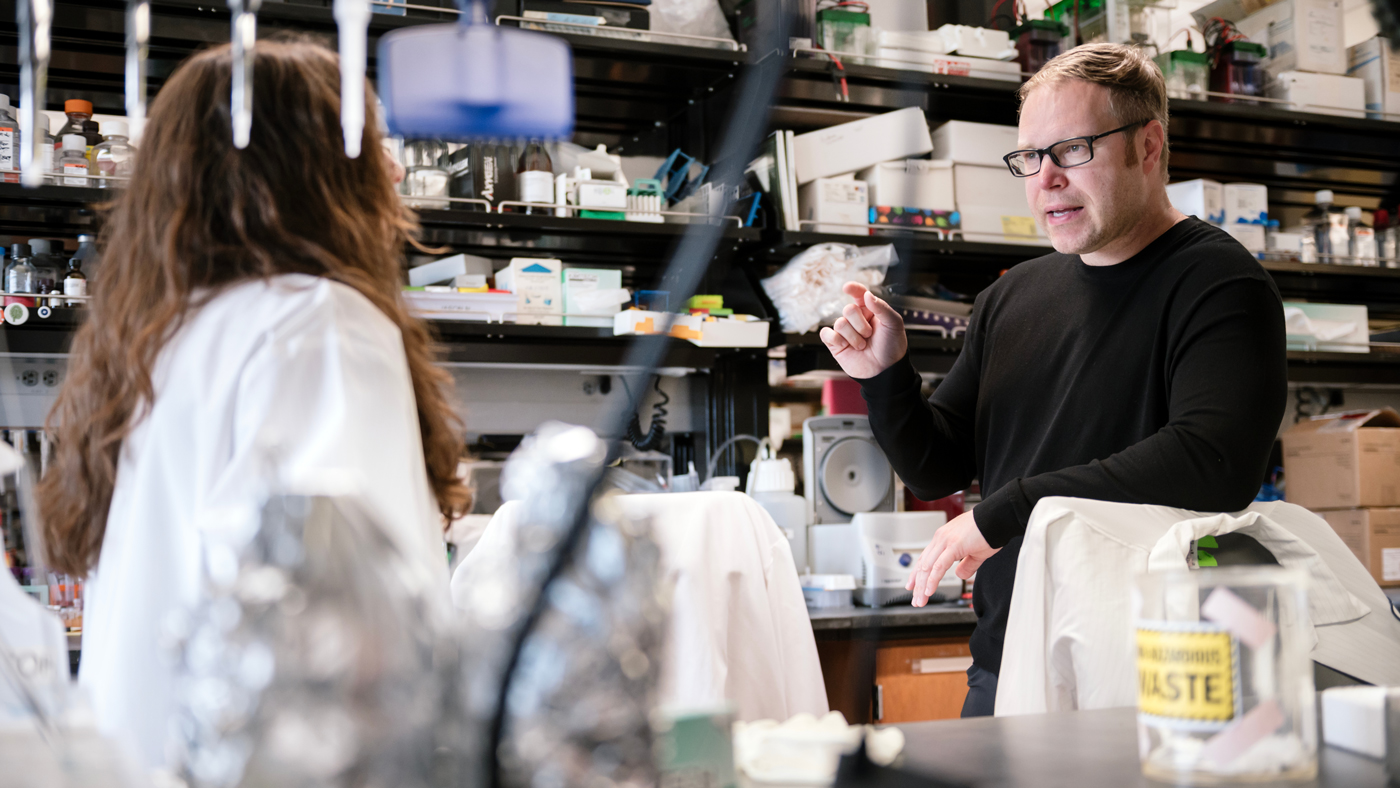
We spoke with Gladstone Investigator Magnus Hoffmann, PhD, about the different types of cancer vaccines, the scientific challenges involved, and the promise these vaccines hold for the treatment of cancer.
Could you start by explaining the different types of cancer vaccines?
There are two broad categories of cancer vaccines. The first is very similar to the vaccines we commonly use to protect ourselves against viral threats like the flu, because some cancers are actually caused by viruses. For instance, the HPV virus is strongly linked to cervical cancer. So, these preventive vaccines, by protecting you against viral infections, also protect you against the cancers that can be caused as a byproduct of infection.
The second type is much newer: therapeutic cancer vaccines. These vaccines are given to a patient when they already have cancer, which makes the word “vaccine” a bit confusing, because it’s more of a treatment than prevention. But therapeutic vaccines essentially work the same way, by training the immune system to attack unwanted cells.
How does the immune system normally deal with cancer, and how are therapeutic cancer vaccines designed to help?
The interesting thing about cancer is that it’s basically our own cells—except they’ve changed and become cancerous. Our immune system can use certain signatures—called tumor antigens—to recognize and attack these cells.
Tumor antigens can be different things. They can be normal proteins that are produced at higher levels than you would usually see in a healthy cell. Or, they can be mutated proteins accumulated by the cancer. Therapeutic cancer vaccines are designed to train the immune system to detect these tumor antigens and attack the cancer cells that carry them.

One challenge is that cancer tumors are extremely good at hiding their antigens. They’re also very good at surrounding themselves with an immunosuppressive microenvironment, which reduces the immune cells’ ability to find and actively destroy the cancer cells.
How can cancer vaccines overcome this challenge?
One strategy that shows a lot of promise is combining cancer vaccines with other immunotherapy approaches.
For instance, some vaccines can be paired with immune checkpoint inhibitors, which essentially release the breaks on immune cells that normally prevent them from attacking healthy cells, but that cancer cells use to hide from the immune system. So, you have the cancer vaccine that trains the immune system to recognize the cancer, and then the checkpoint inhibitor unleashes the immune cells to destroy it—in theory, it’s a perfect solution.
This combination is already being tested and seems to lead to much better survival outcomes for patients. Moderna, for example, is developing a vaccine that works with Merck’s immune checkpoint inhibitor to treat advanced melanoma, a severe type of skin cancer.
Are therapeutic cancer vaccines the same for every patient, or do they need to be customized?
The challenge is that everybody’s cancer is different. Two patients with the same cancer type might have a different set of mutated proteins.
One strategy to get around this problem is to develop an “off-the-shelf” vaccine. If you look across cancer types at the bigger picture, you can try to find recurring signatures that are prevalent in a large number of patients. A vaccine that targets these signatures could help many people, perhaps 30 to 50 percent of patients with a certain cancer type.
“I’ve been fascinated by immunotherapy approaches and the impact they’ve had on the treatment of certain cancers. Some have led to cures, which is just phenomenal.”
Another strategy is to make personalized therapeutic cancer vaccines. For this, you need to analyze a sample of the patient’s tumor, identify tumor antigens you can target, and then generate a personalized vaccine for that patient.
This is a promising approach because you induce the right immune response tailored specifically to the patient’s tumor. One issue, of course, is that it’s a very expensive process that can’t easily allow for widespread use. And it’s time-consuming; it can take one to two months to make the vaccine, which can be more time than some patients have.
Can you give examples of the types of cancer that therapeutic vaccines are currently being developed for?
Much of the early development for therapeutic cancer vaccines has focused on melanoma, and I think there are multiple reasons for that. Not only is it very common and very deadly, but it’s also immunogenic. This means there’s normally a strong immune response against the cancer, making it a prime target for this type of therapy. Also, because melanoma is a skin cancer, it’s easy to obtain biopsies and take them to the lab for analysis to develop customized vaccines. And it’s a good candidate for “off-the-shelf” vaccines, given that it has many well-defined tumor antigens that are recurrent in a large group of patients and that can be targeted by a vaccine.
I’ve seen efforts in other types of cancer as well, including prostate cancer, lung cancer, pancreatic cancer, and many other solid tumors.
What are the risks or side effects associated with cancer vaccines?
For preventive cancer vaccines that work against viruses, it’s easy for the immune system to target the viral proteins—which are foreign and completely different from our own—and not cause harm to the rest of the body.
But it gets tricky for therapeutic cancer vaccines, because cancer cells are ours, and many of their components are the same as those in healthy cells. So, as we develop these vaccines, we have to make sure we elicit a very specific immune response that doesn’t cause adverse effects—we want the immune system to attack the cancer cells, but not the healthy cells.
You plan to expand the scope of your lab to work on cancer vaccines. What are the types of questions you plan to address with your research?
Though we’re new to the cancer field, we want to leverage our expertise in developing innovative vaccine technologies against viruses. One is mRNA vaccine technology, which is a relatively recent approach, but one that I think has a lot of potential for cancer vaccine development.
“I can’t wait to see the day when people can receive a therapeutic cancer vaccine and live, recurrence-free, as if they never had cancer in the first place.”
As you remember from the COVID-19 pandemic, mRNA vaccines can be manufactured extremely quickly and have very adaptable manufacturing properties. If you want to make customized cancer vaccines for individual patients as fast as possible, mRNA vaccines are almost the only way you can do it.
Overall, what strikes me most about the cancer vaccine field is the fact that every tumor is unique, making the “off-the-shelf” approach difficult. But making customized vaccines is not very convenient, and it has many logistical and financial limitations. In my lab, we want to find ways to combine the advantages of both approaches to come up with a solution that can actually work for patients.
What drew you to work on cancer vaccines?
I’ve been fascinated by immunotherapy approaches and the impact they’ve had on the treatment of certain cancers. Some have led to cures, which is just phenomenal. It’s extremely inspiring to see the promise of cancer vaccines.
I also love a really difficult challenge—and this is as tough as it gets. It’s a complicated problem to solve and requires complex technology, but I think we now have the tools to actually tackle it. Over the past decades, our understanding of the immune system and our ability to engineer vaccines has grown enormously.
So, in a way, it’s a perfect field for us to get into. And that’s why I’m very excited to hopefully come up with creative solutions for developing more effective vaccines.
What is your hope for the field of therapeutic cancer vaccines?
My hope is that we can get consistent responses in a very large pool of patients—we want this therapy to work for the majority of patients, and for multiple different cancer types. This won’t be simple, because some tumors are easier for the immune system to access than others. And I think the progress will be gradual, but we’ll get there.
I also want to find a way to make cancer vaccines effective and accessible, meaning they’re not too expensive or time-consuming to produce. Otherwise, they will never be the first line of treatment.
Ultimately, I can’t wait to see the day when people can receive a therapeutic cancer vaccine and live, recurrence-free, as if they never had cancer in the first place. That would be a tremendous success, and I hope our lab will be part of that story.
Up Next

Scientists Decode Gene Circuits of Human Immunity, Fueling New Era of Disease Research
An unprecedented map of 22 million immune cells provides the functional rulebook for virtual biology and next-generation immunotherapies.
New Toolkit Turns Macrophages Into Better Cancer Fighters
Gladstone and UCSF scientists developed a method to genetically edit myeloid cells, immune cells that act as the body’s first responders.
New CRISPR Screening Platform Boosts Power of Immunotherapy Against Solid Tumors
A new screening platform uncovers gene edits that enhance CAR-T cells’ ability to infiltrate and eliminate solid tumors.

Magnus Hoffmann Honored as 2026 Pew Biomedical Scholar
The Gladstone scientist, an expert in vaccine development, is recognized for his pioneering approach to advancing human health and medicine.

Get Involved
Join the Team
Our people are our most important asset. We offer a wide array of career opportunities both in our administrative offices and in our labs.
Open PositionsPartner With Us
Discoveries don’t stay in our labs. Gladstone facilitates spinout companies to advance promising therapies, shortening the path between scientific discovery and helping real patients.
Learn MoreGive
Your gift to Gladstone will allow our researchers to pursue high-quality science, focus on disease, and train the next generation of scientific thought leaders.
Donate Now