Gladstone NOW: The Campaign Join Us on the Journey✕




Oscar Yip is advancing Alzheimer’s research in Yadong Huang’s lab at Gladstone while drawing inspiration from his family, community, and his broader goal of helping patients.
Oscar Yip was born in Colorado to parents who immigrated from Vietnam. The first in his family to attend college, Yip began his academic journey at Occidental College in Los Angeles. Following graduation, he pursued a Fulbright Fellowship in New Zealand, where he earned a master’s degree studying pollution resistance in plants. His path eventually led him to San Francisco, where he’s now pursuing a PhD in biomedical sciences.
Yip currently works in the lab of Yadong Huang, MD, PhD, studying Alzheimer’s disease.
What brought you to Gladstone?
I was drawn to Gladstone by its amazing research. I had heard about Yadong Huang’s lab doing interesting Alzheimer’s disease research and was able to do a rotation in the lab. During my rotation, I got a sense of what a wonderful environment Gladstone fosters for research and collaboration and wanted to be part of the community.
What do you like about Gladstone?
Other than the phenomenal disease-focused research, I like that Gladstone offers so many avenues to connect with other scientists and develop yourself. For example, I had the opportunity to serve as co-president for Gladstone’s Graduate Organization, where I was able to work with wonderful administrative teams and fellow graduate students to organize both social and career development events.
How does your research contribute to understanding or treating specific diseases?
My research is broadly focused on understanding and finding a cure for Alzheimer’s disease. More specifically, our lab studies APOE4, the major genetic risk factor for late-onset Alzheimer’s. APOE is an apolipoprotein in the brain. You can think of it as a shuttle that carries around fats in the brain, which are important for cells to function properly.
There are three versions of this gene, and if an individual has the APOE4 form, they have an increased risk of developing Alzheimer's. So, our lab wants to understand why that’s the case.
My research focuses on understanding how APOE is regulated in neurons and if getting rid of this bad APOE4 in neurons can rescue or stop Alzheimer’s from developing.
Who has been your biggest influence in your scientific career?
My family has had the biggest influence on my scientific career. My parents immigrated from Vietnam, and growing up they always encouraged me to pursue education. They’ve supported me so much throughout my PhD journey.
Also, my grandpa was diagnosed with Alzheimer’s and that really inspired me to do research in this field.
What drives you in your research, especially when facing challenges or setbacks?
What drives my research the most is the broader impact and eventual goal of helping patients. It’s easy to get caught up in the daily tasks and small details, such as an experiment not working out the way I hoped. But reminding myself of the larger goal of contributing to important research to ultimately combat a complex, harmful disease that affects people like my grandpa helps me to keep pushing on.
How do you collaborate with other researchers, both within Gladstone and externally?
Gladstone is a great place for collaboration. On numerous occasions, I’ve walked over to a neighboring lab for reagents, or to just to pick their brain about a new type of experiment I want to run. Everyone is always so helpful and generous with their time.
Within my lab, my mentor also fosters a great environment where the trainees work closely together. From brainstorming new ideas to actively helping with experiments contributing to my project, my fellow graduate students in my lab have been great collaborators.
I’ve also been fortunate enough to collaborate with a lab at Stanford, which resulted in a scientific publication.
What advice would you give to young scientists or students interested in your field?
Be comfortable with things not going smoothly or as you planned them in your head. In reality, everyone experiences times when science takes a different turn or when factors outside of their control affect their research. It’s important to stay resilient. Sometimes the “wrong turns” lead to really cool discoveries.
Additionally, I think it's really important to identify a good support network because it’s essential to have your community there to back you up when you face challenges.
In 2022, you received the Robert and Linda Mahley Career Advancement Award. How did that impact your work?
I attended the Neurodegeneration Keystone Symposia in Whistler, Canada. It was a wonderful opportunity to present my work at a conference, and it really helped me grow as a scientist to be able to practice speaking about my research in a public setting. It was also a great chance to network and meet well-known scientists in the field of Alzheimer’s. I attended many interesting talks and came back to the lab encouraged to pursue new avenues in my own thesis research.
What do you do when you’re not working?
I like going to see the latest movies, playing tennis, running, and hanging out with my cat, Theo.
What is your hidden talent?
I don’t know if this is a talent or luck, but I would say I have a talent in surrounding myself with really good friends. Throughout all the different stages of my education, I’ve been fortunate enough to meet some truly amazing friends for life. My friends offer such a great support network for me. I like to think that I have a talent for finding great people who look out for me.
Want to Join the Team?
Our people are our most important asset. We offer a wide array of career opportunities both in our administrative offices and in our labs.
Explore CareersMeet Gladstone: Ayush Midha
Article
September 21, 2026
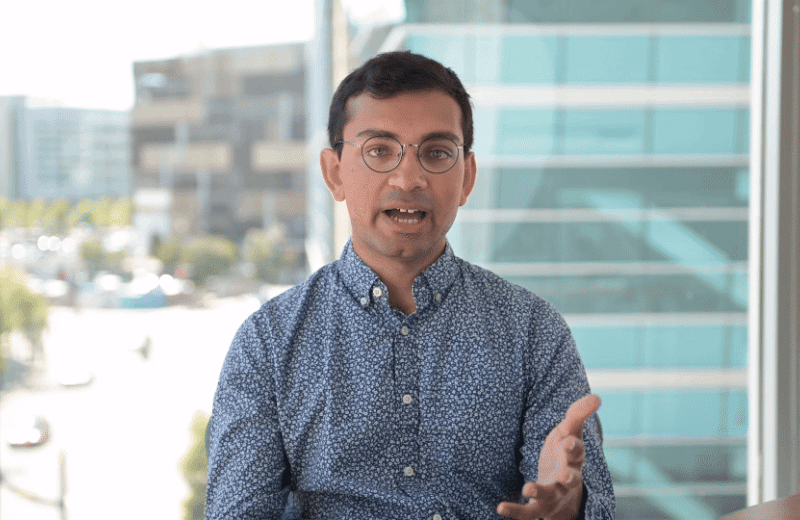
Meet Gladstone: Ayush Midha
Ayush Midha, a graduate student in the Jain Lab, studies how the body's metabolism adapts to low oxygen—work that's uncovered backup energy pathways, potential fertility treatments, and a link between oxygen levels and tumor growth.
Profile Jain Lab Graduate Students and Postdocs MetabolismMeet Gladstone: Lexi Schneider
Article
August 24, 2026
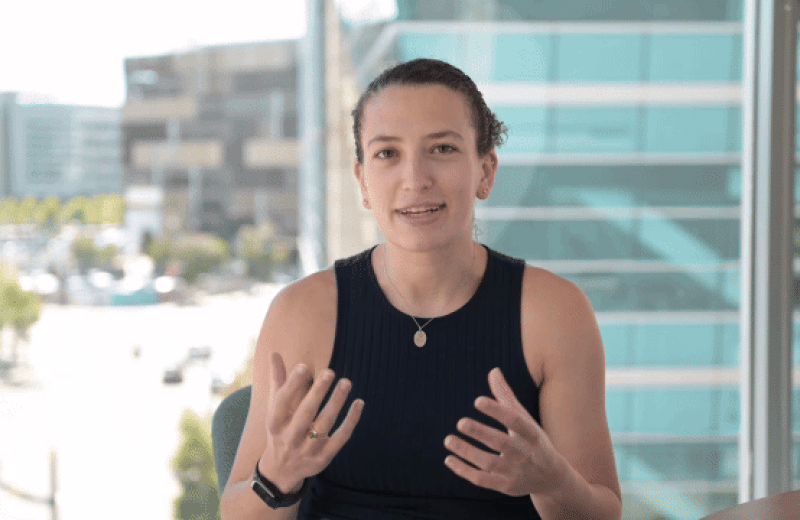
Meet Gladstone: Lexi Schneider
Meet Lexi Schneider, a PhD student using innovative technology to better understand the blood brain barrier.
Profile Graduate Students and Postdocs Yang LabAn Ancient Genetic Twist and Its Modern Impact on Brain Disease
Article
July 14, 2026
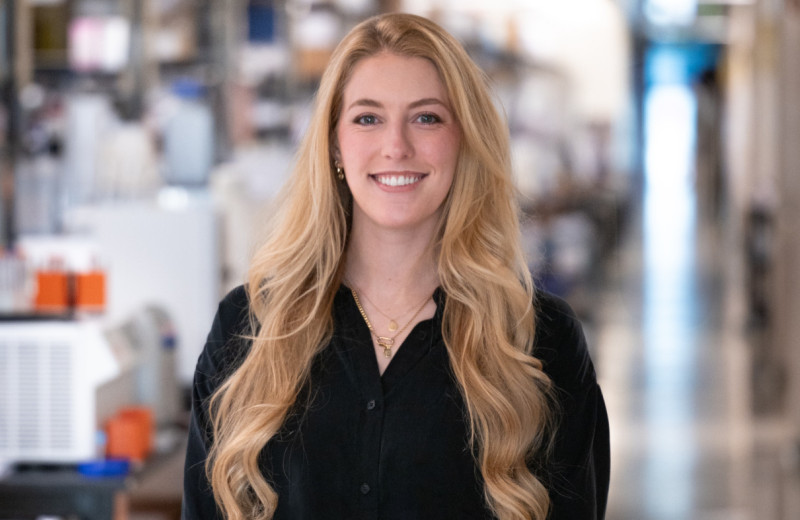
An Ancient Genetic Twist and Its Modern Impact on Brain Disease
NOMIS–Gladstone Fellow Cathrine Sant is studying an enigmatic region of the human genome linked to neurodegenerative disease risk.
Neurological Disease NOMIS Graduate Students and Postdocs Profile