Gladstone NOW: The Campaign Join Us on the Journey✕




Steve Finkbeiner, MD, PhD, and his lab at Gladstone Institutes developed the first ever “thinking microscope,” which uses AI not only to analyze data, but also to design and conduct experiments—all without human intervention.
The fully automated platform can track individual cells for hours, days, or even months, allowing researchers to simultaneously run thousands of individual experiments and watch as disease unfolds in living cells.
The team is now working to integrate an AI method called reinforcement learning to enable the microscope to do experiments on its own, learn from what it did, and then solve problems it’s tasked with.
Using this AI-powered tool, Gladstone scientists are trying to better understand the cause of diseases like Alzheimer’s disease, Parkinson’s disease, and ALS.
In this video, Steve Finkbeiner and Jeremy Linsley explain how this microscope works and how it could eventually lead to new treatments, or cures.

Gladstone NOW: The Campaign
Join Us On The Journey
Science in Seconds | An Unprecedented Map of Human Immune Cells
Video
August 28, 2026
Science in Seconds | An Unprecedented Map of Human Immune Cells
In this video, Gladstone scientists Emma Dann and Ronghui Zhu explain how their new study offers a powerful framework for designing cancer immunotherapies and treating autoimmune conditions.
Turning the Tide on Tau: Q&A With Gladstone’s Lennart Mucke
Article
July 1, 2026
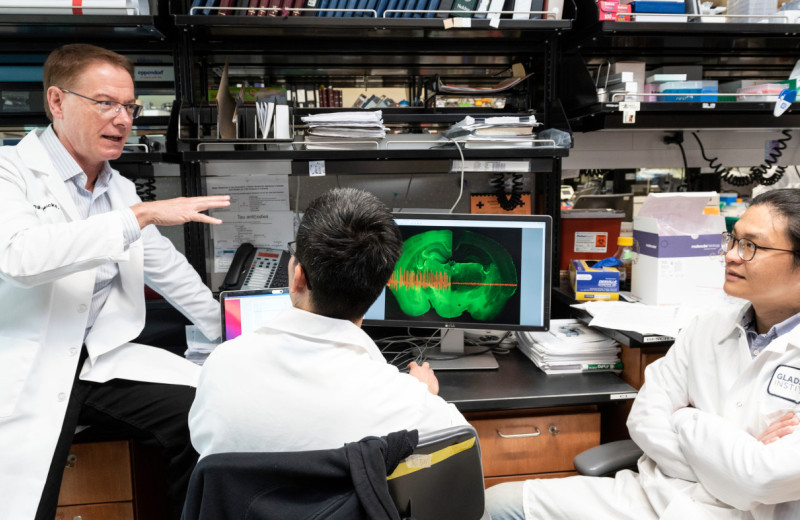
Turning the Tide on Tau: Q&A With Gladstone’s Lennart Mucke
Nearly 20 years after his landmark study uncovered novel roles of tau in Alzheimer’s disease, Gladstone's Lennart Mucke shares his perspective on new clinical data that could transform the future of brain health.
Mucke Lab Alzheimer’s Disease Gladstone Experts Neurological Disease News ReleaseThis Is AI Decoding the Genetic Cause of Disease
Video
March 23, 2026
This Is AI Decoding the Genetic Cause of Disease
In this video, Katie Pollard and Deepak Srivastava explain how Gladstone scientists are combining AI models with novel tools in the lab to finally decode the entire human genome.
Gladstone Experts Pollard Lab Srivastava Lab AI