Gladstone NOW: The Campaign Join Us on the Journey✕




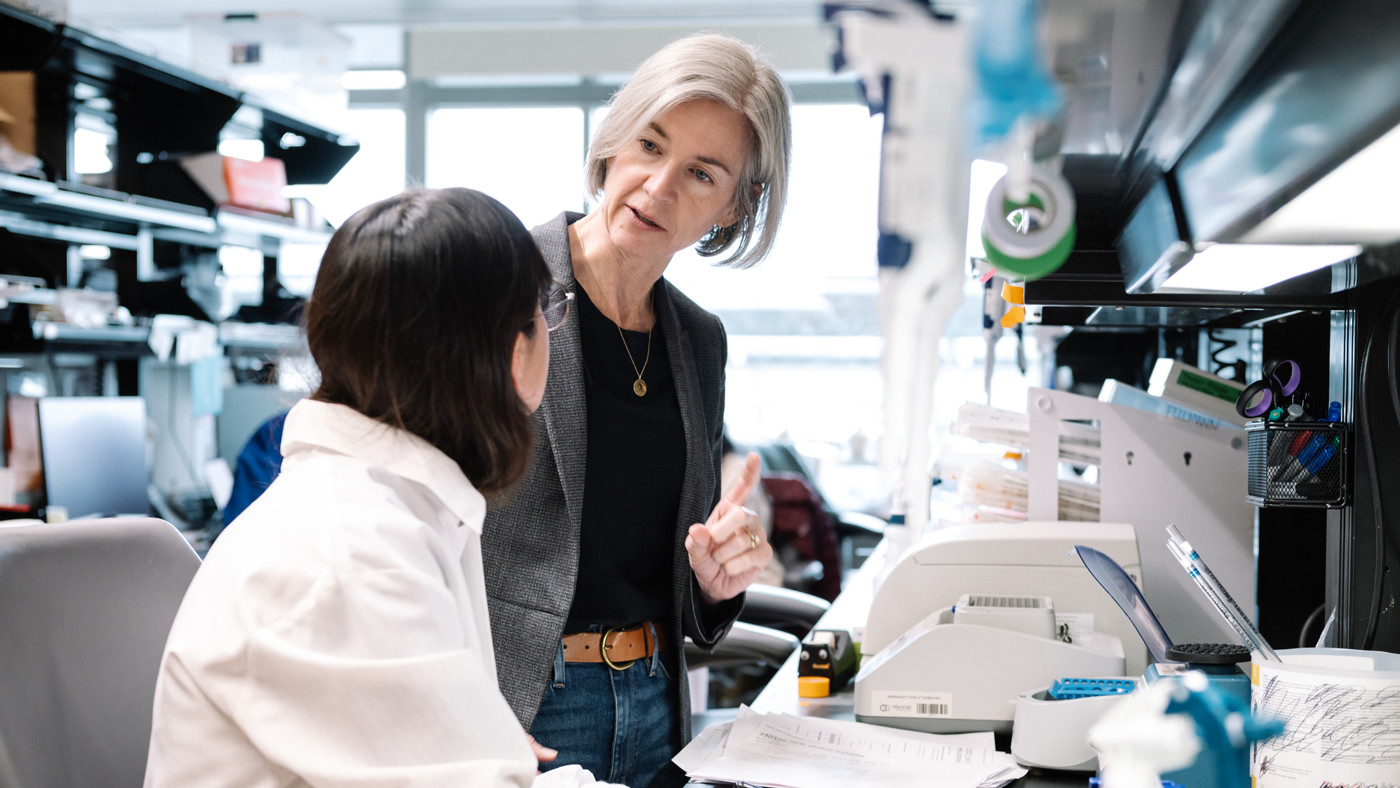
A team led by Jennifer Doudna developed an innovative chromatin-shredding technique shown to destroy cancer cells carrying a prevalent mutation while keeping healthy cells intact.
The job of tumor suppressor proteins is right in their name: stopping us, on a cellular level, from developing cancerous tumors. And fortunately, everyone has them. But when they’re not working properly, the cell is left with limited defenses.
In a new paper published in the journal Nature, researchers at the Innovative Genomics Institute (IGI) at UC Berkeley, Gladstone Institutes, and UC San Francisco (UCSF)—along with collaborators at University of Utah and Utah State University—report they’ve found a way to destroy those malfunctioning suppressor cells using CRISPR gene editing technology, potentially opening the door to a new way of treating difficult cancers.
The creative new CRISPR-based approach can selectively destroy cells carrying a mutation in a tumor suppressor found in nearly half of all cancers and up to 70–90 percent of cases of some of the most difficult-to-treat cancers, including ovarian, pancreatic, and non-small cell lung cancer.
“Not only can this approach target the ‘undruggable’ cancers that we know, we can also easily and quickly adapt this to new mutations,” says Jennifer Doudna, PhD, a senior investigator at Gladstone, founder of IGI, and a professor at UC Berkeley. “This is an exciting development for cancer therapies, and potentially for other applications as well.”
Doudna, who received the 2020 Nobel Prize in Chemistry for her co-discovery of the CRISPR-Cas9 gene editing technology, is the senior author of the study.

In Jennifer Doudna's lab, scientists engineered a new CRISPR system that detects a cancer signature within a cell and slices up all the genetic material in that specific cell, effectively destroying cancer cells while leaving healthy cells completely untouched.
A Common Mutation Behind Many Cancers
During his graduate studies on cancer evolution, Jingkun Zeng, PhD, the study’s first author, was looking to find new ways to target “undruggable” cancer mutations—so called because they have historically been very difficult to target directly with drugs—and thought tumor suppressors might hold the key.
“If you look at all the cancer drugs right now, they're mostly inhibitors; they suppress an overactive cancer gene,” says Zeng, a visiting postdoctoral researcher in Doudna’s lab. “But for tumor suppressors, it’s the opposite. When they develop a mutation, they lose their function. They can no longer suppress tumor formation.”
The role of a specific protein called p53 as a tumor suppressor has been known since the late 1980s. Mutations in this gene help cancers grow uninhibited and are common across many cancer types. Because of this, and because it’s often an early mutation that drives later mutations in the cancer-causing cascade, researchers have long considered it one of the premium targets for cancer therapy.
Despite the promise, not a single p53-targeting drug has made it to the market.
Not only do tumor suppressor proteins lack “druggable pockets,” the areas on the molecule where small molecule drugs can fit like a key in a lock, it’s not clear how drugging mutated p53 protein could help it do its job.
Going Back to CRISPR Basics
Zeng, inspired by reading a paper from Doudna’s lab on using CRISPR to shred repetitive sequences in brain tumors, thought there might be an alternative to reactivating broken tumor suppressors: finding cells with cancer-specific mutations and eliminating them entirely.
“People generally, and especially in the gene editing field, want to fix genes or knock out genes,” Zeng says. “But what I wanted to do here is completely different. I wanted to destroy abnormal cells, precisely and safely.”
This approach takes CRISPR back to its roots; in nature, CRISPR systems are destroyers, not fixers. They defend microbes against infections by cutting the genetic material of invading viruses to prevent damage and replication. Instead of reactivating a broken p53 protein, the research team reasoned they could harness CRISPR’s natural ability to find cells with specific mutations and use its cutting ability to selectively destroy those cells.
The research team engineered a CRISPR system called CRISPR-Cas12a2 to look for the specific RNA transcript produced only by cells with the mutated cancer gene. In bacteria, this CRISPR acts as a suicide pill, intentionally killing a cell that has been infected by a virus to prevent its spread.
“When people treat cancer with chemotherapy or radiotherapy, that's essentially killing all the dividing cells in the body, including healthy cells. With this technology, it's much, much more precise.”
In the newly engineered version, once the system detects a cancer signature within a cell, the Cas12a2 enzyme activates and initiates “chromatin shredding,” slicing up all the genetic material inside that specific cell. The widespread demolition effectively destroys mutated cells while leaving healthy cells completely untouched.
“This new approach reimagines how CRISPR can be used as a precision tool to find and eliminate cancer cells across a variety of cancer types,” says co-author Alan Ashworth, PhD, president of the Helen Diller Family Comprehensive Cancer Center at UCSF and co-director of the CRISPR Cures for Cancer initiative. “It may open up many new previously undruggable targets for cancer therapy. For this approach to be useful in real-world situations, however, it has to be precise and not cause harm to healthy cells.”
To test the accuracy of this method, the team introduced the CRISPR-Cas12a2 system into mammalian cell cultures containing both healthy and cancerous cells. The system successfully distinguished between the two, initiating chromatin shredding and cell death only when the specific mutant RNA was present. Cells carrying the healthy, wild-type version were left almost entirely unharmed.
“Those two cell lines, they just differed by one nucleotide change,” Zeng says. “When people treat cancer with chemotherapy or radiotherapy, that's essentially killing all the dividing cells in the body, including healthy cells. With this technology, it's much, much more precise.”
A Slicer for All Occasions
While the team is excited about the results with p53, Zeng thinks the main advantage of this technology is that it is programmable, just like more traditional types of CRISPR gene editing.
“In cancer, when there's a new mutation, we can now easily make a new guide RNA to find the new mutation and test if it's effective. This is much faster than making a small molecule drug or antibody therapy.” Zeng says.
Zeng is now thinking about the next steps with this approach and how to overcome some of its limitations. Much like other CRISPR therapies, efficient delivery into all targeted calls is a critical challenge. He’d also like to explore whether using the technology in combination with other therapies may prove useful for some cancers.
This article is adapted from an Innovative Genomics Institute press release.
For Media
Julie Langelier
Associate Director, Communications
415.734.5000
Email
About the Study
The study, “Targeting Cancer-Specific Mutations with RNA-Triggered Chromatin Shredding,” appears in the June 8, 2026 issue of Nature. Authors include Jingkun Zeng, Zhiyuan Cheng, Huadong Chen, Zhaojun Wang, Jared Thompson, Kadin T. Crosby, Hesong Han, Arushi Singhal, Wayne Ngo, Chenglong Xia, Daniel Rosas-Rivera, Zeyuan Zhang, Min Hyung Kang, Ying Mao, Morgan E. Diolaiti, Giselle C. Lee, John F. X. Diffley, Yixuan Song, Longhui Qiu, Nathan M. Krah, Niren Murthy, Ryan N. Jackson, Yang Liu, Alan Ashworth, and Jennifer A. Doudna.
About Gladstone Institutes
Gladstone Institutes is an independent, nonprofit life science research organization that uses visionary science and technology to overcome disease. Established in 1979, it is located in the epicenter of biomedical and technological innovation, in the Mission Bay neighborhood of San Francisco. Gladstone has created a research model that disrupts how science is done, funds big ideas, and attracts the brightest minds.
About the Innovative Genomics Institute
Founded by Nobel Laureate Jennifer Doudna, the Innovative Genomics Institute uses genome engineering to solve humanity’s greatest problems in health, climate, and sustainable agriculture. The IGI is working toward a world where genomic technology is routinely applied to treat genetic disease and empower the future of agriculture. Learn more.
Featured Experts

Gladstone NOW: The Campaign
Join Us On The Journey
How a Single Viral Protein Hijacks Immune Cells to Supercharge COVID-19 Infection
Article
September 18, 2026
How a Single Viral Protein Hijacks Immune Cells to Supercharge COVID-19 Infection
A new discovery reveals how a SARS-CoV-2 protein reprograms immune cells to accelerate viral spread—and points to a new strategy for therapeutic intervention.
News Release Ott Lab COVID-19 Infectious DiseaseThe 2026 Ogawa-Yamanaka Stem Cell Prize Awarded to Jun Takahashi

Article
September 14, 2026
The 2026 Ogawa-Yamanaka Stem Cell Prize Awarded to Jun Takahashi
Takahashi is recognized for his pioneering work translating iPS cell technology into a clinically approved therapy for Parkinson’s disease.
Ogawa Stem Cell Prize Stem Cells/iPSCs Regenerative Medicine News Release AwardsScientists Decode Gene Circuits of Human Immunity, Fueling New Era of Disease Research

Article
August 28, 2026
Scientists Decode Gene Circuits of Human Immunity, Fueling New Era of Disease Research
An unprecedented map of 22 million immune cells provides the functional rulebook for virtual biology and next-generation immunotherapies.
Marson Lab Genomic Immunology Cancer Autoimmune Diseases News Release