Gladstone NOW: The Campaign Join Us on the Journey✕



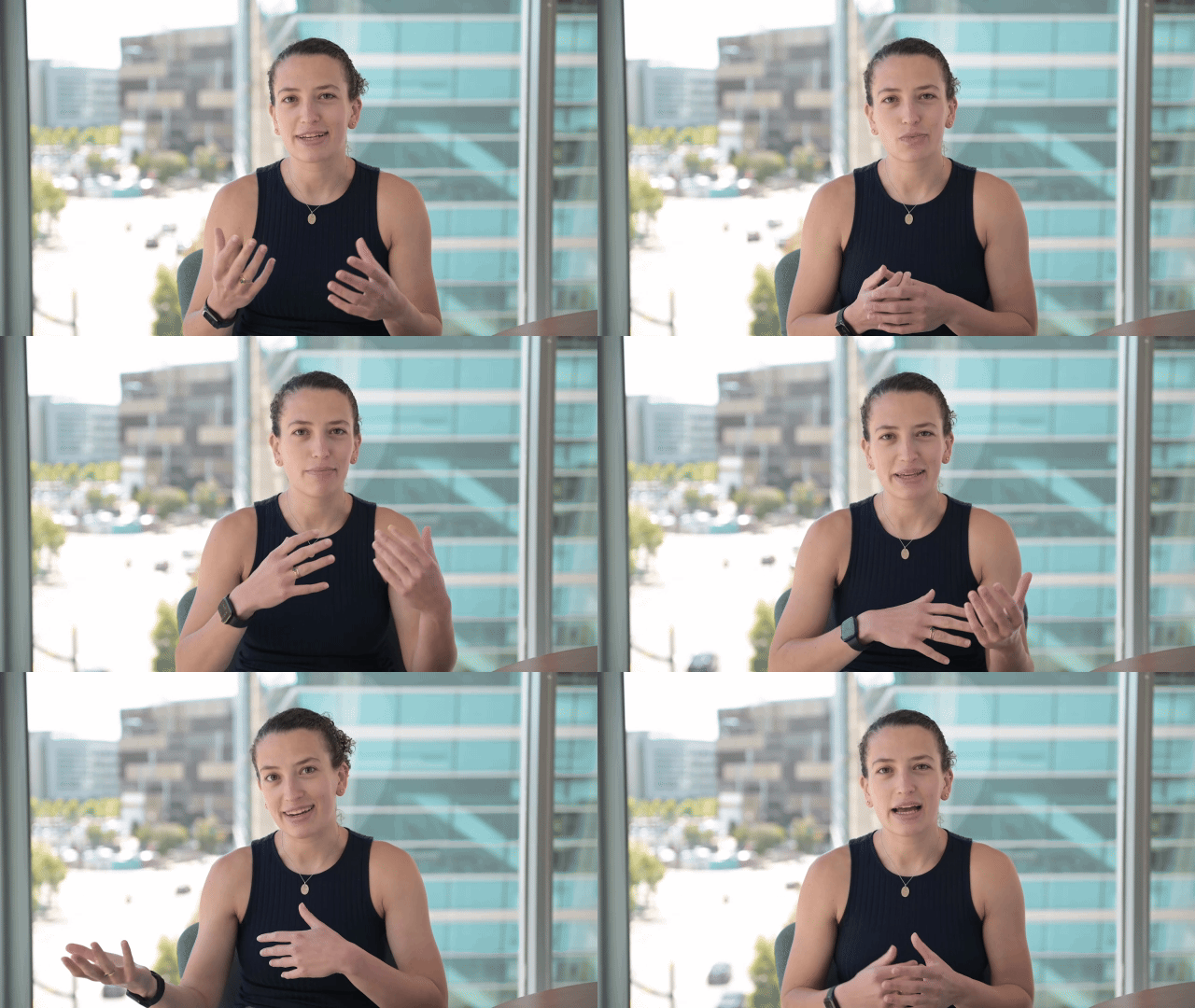
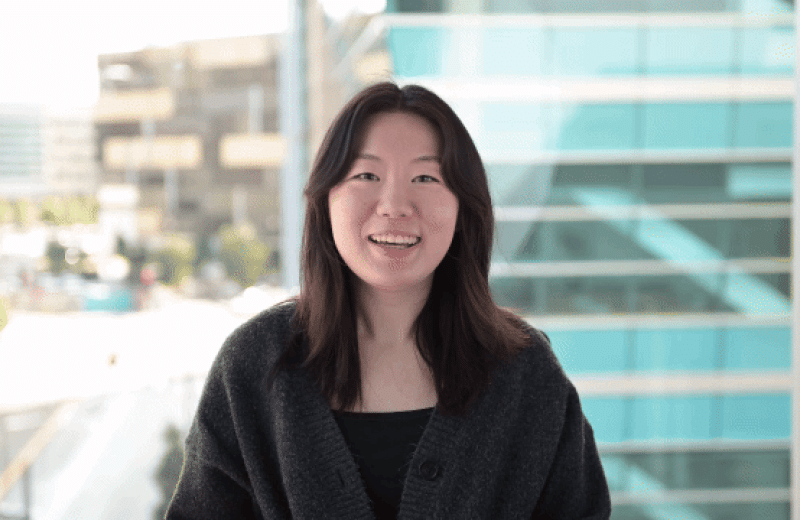
Lexi Schneider develops new technologies to help better understand the blood brain barrier.
Lexi Schneider grew up in the Philadelphia area, and studied biological engineering and computer science at MIT. After graduation, she decided to head west to San Francisco to pursue a PhD in biomedical sciences at UC San Francisco. There, she joined the labs of Andrew Yang and Jason Cyster, where she develops new technologies to help better understand the blood brain barrier.
What brought you to Gladstone?
I joined Andrew Yang's lab when he was a Sandler Fellow at UCSF. A few years into my PhD, Andrew accepted a position at Gladstone as an independent investigator, so our lab packed everything up and moved across the city together. That move ended up being a really unique experience because I got to spend different parts of my PhD in both the UCSF Parnassus and Gladstone communities, and I've really enjoyed becoming part of both.
What do you like about Gladstone?
One of my favorite things about Gladstone is that it has a small, collaborative, mission-driven culture. People are genuinely excited about each other's science and willing to help, which makes it a great place to do research.
Also shoutout to Gladstone’s soccer team which has been a fantastic way to meet people outside my own lab.
What are the key areas of research you’re focused on?
I'm interested in how the brain communicates with the rest of the body. A key player in that process is the blood-brain barrier, a protective layer of cells between your bloodstream and your brain. It carefully controls what can enter the brain from the bloodstream (and vice versa), protecting it from harmful substances, but also making it difficult for medicines to reach the brain.
The tricky part is it's hard to study these cells without taking them out of the body, and once you do, they don’t behave normally.
To get around that, I build tools that let us study cells where they naturally live. For my PhD, I developed an enzyme that can label the molecules surrounding a specific cell inside a living animal. The labels allow us to see what proteins are on the cell's surface, what environment it's sitting in, and which neighboring cells it's interacting with, giving us a much clearer picture of how cells communicate in healthy and diseased tissues. We've called this tool TORCH because it helps us illuminate what's going on inside the brain.
How does your research contribute to understanding or treating specific diseases?
One of the biggest obstacles in treating brain diseases is simply getting medicines into the brain. The blood-brain barrier does such a good job protecting the brain that it also blocks most drugs.
Using the technology we developed, we've been able to identify proteins on the blood-brain barrier that are accessible from the bloodstream and could potentially act as "portals" for therapeutics. We've discovered several promising receptors that can shuttle molecules into the brain. The long-term goal is to use these discoveries to develop better ways to deliver drugs for neurodegenerative diseases and other brain disorders.
How does interdisciplinary collaboration enhance the quality and impact of your research?
My research has always been highly interdisciplinary, and I think some of the most exciting scientific advances happen at the intersection of different fields. My PhD is a great example of this.
I was co-mentored by Andrew Yang and Jason Cyster, which gave me the opportunity to combine bioengineering, neuroscience, and immunology in my research. I've also collaborated with the Huang lab to translate our work into human iPSC-derived neuron models, and with mass spectrometry experts across the country who helped us generate proteomics datasets of the blood brain barrier.
Because I develop research tools, collaboration is especially important. My hope is that technologies like TORCH can be adopted by researchers studying many different biological systems, enabling discoveries well beyond my own field.
Who or what has been your biggest influence in your scientific career?
I was fortunate to have strong female mentors when I was first getting into science. My high school science teacher, Mrs. Gallagher, first sparked my excitement for biology, and my early mentors (shoutout to Michaela TerAvest, Janna Dominico, and Laura Krafjack) encouraged me to ask difficult questions and pursue opportunities I might not have thought I was ready for. Seeing strong women thriving in science helped me imagine what my own career could look like, and they've inspired me to be that same kind of mentor for others.
What do you do when you’re not working?
Outside of lab, I play soccer several times a week on teams around San Francisco. When I’m not playing, I also follow women's sports (go Valkyries and Bay FC!).
I also love hiking, exploring California, listening to music, and spending time with friends.
What is your hidden talent?
I’ve always loved art—painting and drawing are some of my favorite ways to clear my mind and recharge.
More recently, I’ve also branched out to musical theater. I was in the ensemble for a production of Legally Blonde: The Musical earlier this year!
What advice would you give to young scientists or students interested in your field?
Science can be very rewarding, but it's also full of failure. Most experiments don't work the first time, and that's just part of the process. Because of that, it's really important to build a strong support system and have interests outside the lab that keep you grounded. I'd also encourage students to keep reading broadly about exciting discoveries, not just in their own field, to keep fueling their basic curiosity and love of science.
Want to Join the Team?
Our people are our most important asset. We offer a wide array of career opportunities both in our administrative offices and in our labs.
Explore CareersAn Ancient Genetic Twist and Its Modern Impact on Brain Disease
Article
July 14, 2026
An Ancient Genetic Twist and Its Modern Impact on Brain Disease
NOMIS–Gladstone Fellow Cathrine Sant is studying an enigmatic region of the human genome linked to neurodegenerative disease risk.
Neurological Disease NOMIS Graduate Students and Postdocs ProfileMeet Gladstone: Kevin Pastores
Article
June 23, 2026
Meet Gladstone: Kevin Pastores
Kevin Pastores, assistant core director of Gladstone’s Flow Cytometry Core, helps researchers across disciplines design experiments, analyze complex cellular data, and harness emerging technologies like AI to accelerate discovery.
Profile Flow Cytometry CoreMeet Gladstone: Shu Zhang
Article
April 22, 2026
Meet Gladstone: Shu Zhang
Graduate student Shu Zhang uses machine learning to reveal how DNA variation shapes genome structure and drives disease.
Postdoctoral and Graduate Student Education and Research Development Affairs Graduate Students and Postdocs Profile