


Two Proteins’ Destructive Dance
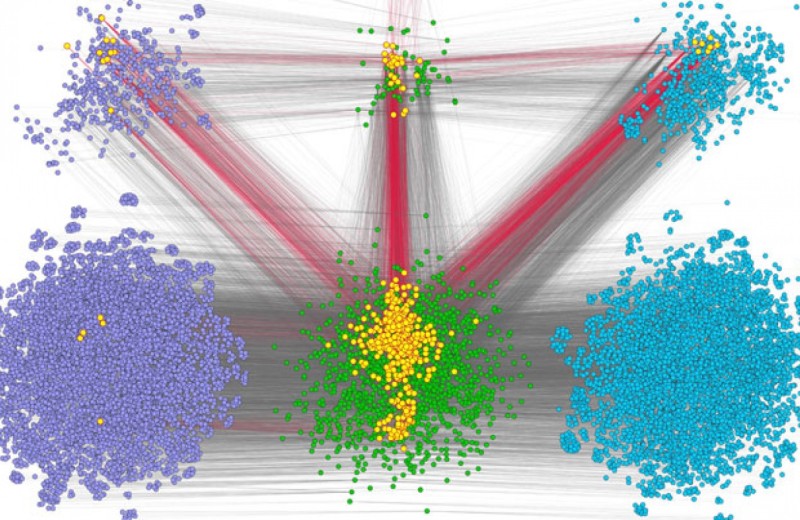
Revolutionary imaging technique reveals that a unique protein interaction may be key to driving the most common genetic cause of Parkinson’s disease
Finkbeiner LabGladstone NOW: The Campaign Join Us on the Journey ✕
1261 - 1275 of 1392 Results Clear All
Revolutionary imaging technique reveals that a unique protein interaction may be key to driving the most common genetic cause of Parkinson’s disease
Finkbeiner LabSAN FRANCISCO, CA—Research led by scientists at the Gladstone Institutes has identified the precise chain of molecular events in the human body that drives the death of most of the immune system’s CD4 T cells as an HIV infection leads to AIDS.
Greene Lab Infectious Disease HIV/AIDSSAN FRANCISCO, CA—In 2012 the HIV antiretroviral drug Truvada became the first and only medication approved by the FDA for HIV prevention.
Grant Lab Infectious Disease HIV/AIDSSAN FRANCISCO, CA—Alzheimer’s disease is one of the greatest challenges facing modern medicine, but there is new hope in the fight against this deadly disease.
Huang Lab Mahley Lab Neurological Disease Alzheimer’s DiseaseSAN FRANCISCO, CA—For some, the disease multiple sclerosis (MS) attacks its victims slowly and progressively over a period of many years. For others, it strikes without warning in fits and starts.
Akassoglou Lab Neurological Disease Multiple SclerosisSAN FRANCISCO, CA—What does it mean to be human? According to scientists the key lies, ultimately, in the billions of lines of genetic code that comprise the human genome. The problem, however, has been deciphering that code.
Center for Systems and Therapeutics Pollard Lab Big DataSAN FRANCISCO, CA—One of biology’s most fundamental processes is something called transcription. It is just one step of many required to build proteins—and without it life would not exist. However, many aspects of transcription remain shrouded in mystery.
Infectious Disease Ott Lab Basic ScienceSAN FRANCISCO, CA—Perhaps the single greatest barrier to curbing the spread of HIV/AIDS is the dormant, or “latent,” reservoir of virus, which is out of reach of even the most potent medications.
Greene Lab Infectious Disease HIV/AIDSSAN FRANCISCO, CA—Lennart Mucke, MD, who directs neurological research at the Gladstone Institutes, next week will receive the ARCS Foundation’s 2013 Pacesetter Award for his lifelong dedication to overcoming Alzheimer’s disease—and for mentoring students to take a similar approach.
Mucke Lab Neurological Disease Alzheimer’s DiseaseSAN FRANCISCO, CA—In an unprecedented move, the California Academy of Sciences today will induct two scientists from the Gladstone Institutes’, President R. Sanders “Sandy” Williams, MD, and Investigator Katherine Pollard, PhD, as Academy Fellows, bestowing yet another honor on two of San Francisco's most esteemed scientists.
Pollard Lab PurchasingSAN FRANCISCO, CA—Three Gladstone scientists have won research awards from divisions of the National Institutes of Health (NIH) equaling an approximate total of $12.5 million over five years for their groundbreaking research to overcome HIV/AIDS.
HIV/AIDS Infectious Disease Greene Lab Sanjabi Lab Weinberger LabSAN FRANCISCO, CA—There is no easy way to study diseases of the brain. Extracting brain cells, or neurons, from a living patient is difficult and risky, while examining a patient’s brain post-mortem usually only reveals the disease’s final stages.
Huang Lab Alzheimer’s Disease Stem Cells/iPSCsSAN FRANCISCO, CA—In the aftermath of a heart attack, cells within the region most affected shut down. They stop beating. And they become entombed in scar tissue.
Srivastava Lab Stem Cells/iPSCs Stem Cells/iPSCsSAN FRANCISCO, CA and COLLEGE STATION, TX—An enzyme is a tiny, well-oiled machine. A class of proteins that are made up of multiple, interlocking molecular components, enzymes perform a variety of tasks inside each cell.
Basic Science Krogan LabSAN FRANCISCO, CA—Alzheimer’s, Huntington’s, Parkinson’s. Names forever linked to what they represent: diseases that ravage the brain’s neurons and leave entire regions to wither and die.
Finkbeiner Lab Huntington’s Disease