



Nadia Roan investigates the mechanisms by which pathogenic viruses can persist and cause disease in people. A major focus of her lab is to understand the mechanisms behind the persistence of the long-lived HIV reservoir, as well as how, in rare instances, certain individuals can naturally control HIV replication in the absence of antiretroviral therapy (ART). The Roan Lab is also probing the features of T cells, HIV’s normal targets, that make these cells susceptible to various forms of HIV infection, ranging from “silent” latent infection to “active” productive infection.
Her lab also studies how SARS-CoV-2 infection can cause long COVID, and the impact of SARS-CoV-2 immunity on disease manifestation. Finally, her lab is actively studying the role of immune cells in female fertility and infertility. Roan’s work has implications for developing cures against HIV/AIDS, management and treatment of Long COVID, and women’s health.
Disease Areas
Areas of Expertise
Lab Focus
Research Impact
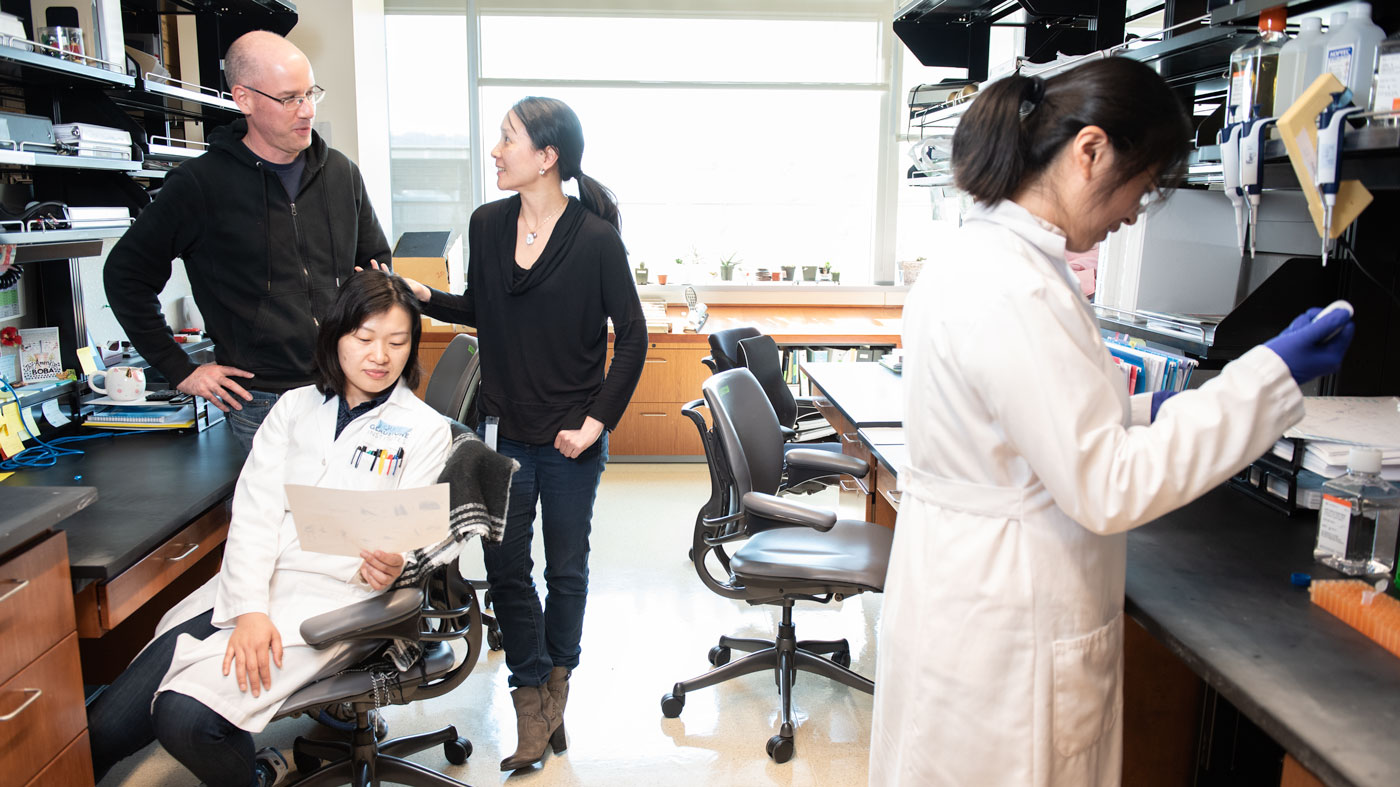
Roan’s lab has characterized the cells that harbor HIV in individuals whose infection is suppressed by antiretroviral therapy (ART), and the immune responses that can recognize these infected cells. The lab is now further characterizing the mechanisms by which HIV-infected cells can persist in the face of ART, using a variety of high-dimensional single-cell analysis approaches such as CyTOF, single-cell sequencing, and high-parameter imaging. Roan and her team are also developing approaches to directly target and eliminate these cells as a strategy to decrease the chronic inflammation and co-morbidities associated with HIV infection. These studies will pave the way for establishing strategies to achieve an ART-free, functional cure for HIV.
The Roan Lab is also interrogating other aspects of HIV infection, including understanding the mechanisms by which the virus transmits across mucosal barriers such as the female reproductive tract, and the molecular basis of latent versus productive HIV infection. In addition, Roan’s lab has successfully applied high-parameter phenotyping to deeply characterize the differentiation states, functional attributes, and homing properties of SARS-CoV-2-specific T cells elicited by infection, vaccination, and hybrid immunity, as well as in the context of long COVID. Ongoing studies aim to leverage this knowledge to move toward the development of novel strategies to treat long COVID, a condition of growing burden and impact—particularly for women, which it disproportionately affects—but for which there are no widely available, evidence-based treatments.
Professional Titles
Senior Investigator, Gladstone Institutes
Professor, Department of Urology, UC San Francisco
Bio
Nadia Roan is a senior investigator at Gladstone Institutes and a professor of urology at UC San Francisco (UCSF).
She received her undergraduate training from UC Berkeley, and completed her doctorate in the biological and biomedical sciences program at Harvard Medical School studying T cell responses to the bacterium Chlamydia trachomatis. She conducted her postdoctoral studies at Gladstone Institutes, where she studied the mechanisms by which mucosal factors, including those present in human semen, influence HIV infection.
The current focus of her lab is to understand how persistent viruses including HIV cause human disease, and the impact of viral-specific immunity on the course of disease.
How Did You Get Your Start in Science?
After I finished my college freshman year, I joined a lab where I got introduced to the whole concept of experimental research, and got hooked from there on!
Honors and Awards
2013 Hellman Award for Early-Career Faculty
2013 K99 Pathway to Independence Award
2012 Gladstone Institute of Virology and Immunology Award for Scientific Excellence
2012 Centers for AIDS Research Early Career Award of Excellence in Basic Research
Publications
Contact
Nadia Roan
Email
415.734.4883
Lilly Miranda
Administrative Associate
415.734.4857
Email