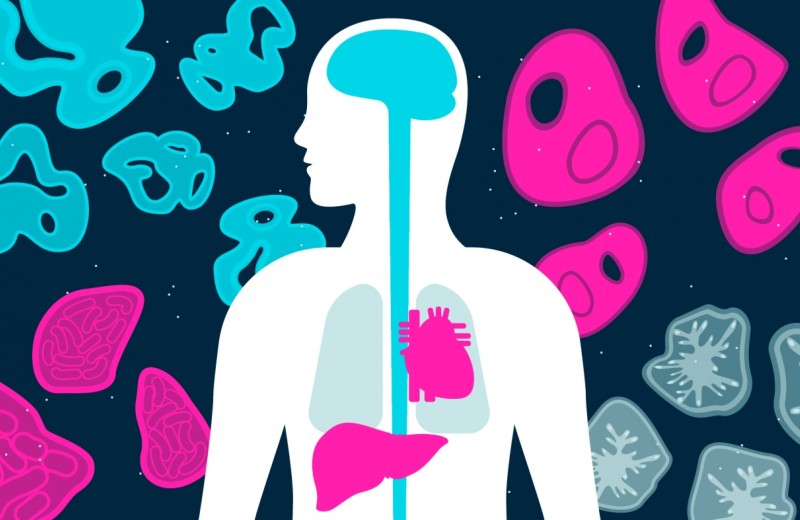
At Gladstone, scientists aren’t just using artificial intelligence—they’re building it. From decoding the human genome to uncovering the root causes of disease, researchers are harnessing AI to make sense of complex biological data and turn insights into real-world therapies.
Discover how AI is transforming biomedical discovery and accelerating the path toward life-saving treatments.
Sign Up for Our Newsletter
Gladstone has launched a series to share the many ways our scientists are using—and developing—AI tools for biomedical research. Each piece highlights a fascinating application of this technology and how it’s shaping our health. Sign up for our newsletter to have these stories delivered to your inbox.
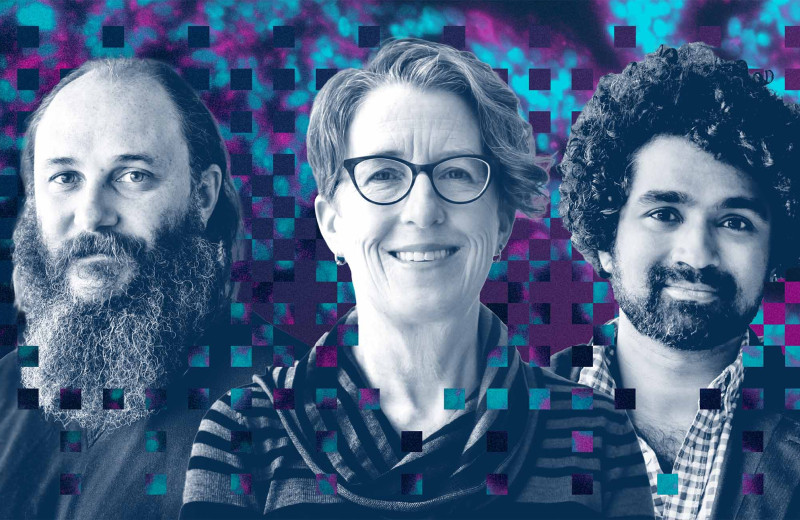
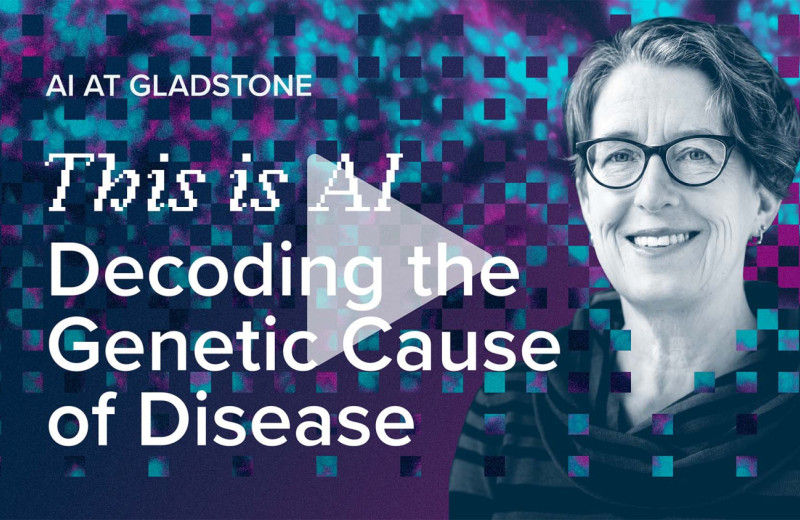
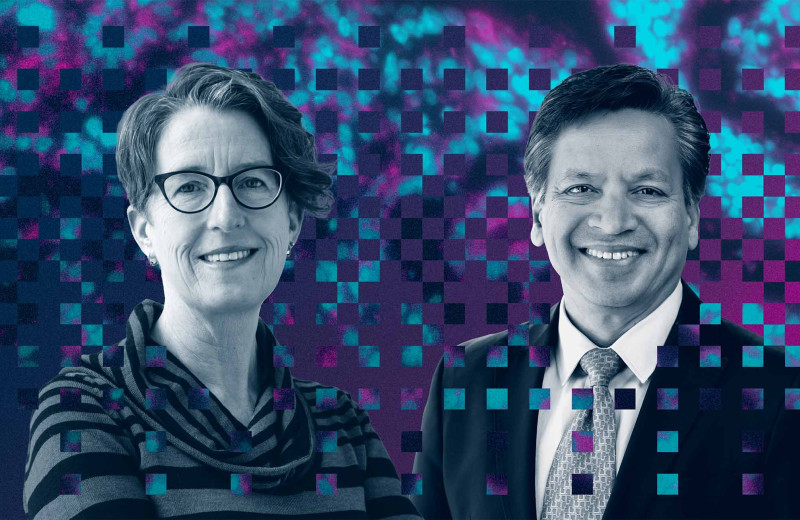
In this video, Katie Pollard and Deepak Srivastava explain how Gladstone scientists are combining AI models with novel tools in the lab to finally decode the entire human genome.
Gladstone scientists are developing new AI tools that promise to revolutionize how science is done and lead to new treatments for the most devastating diseases.
SLAS—Steve Finkbeiner, director of the Center for Systems and Therapeutics, was selected as the recipient of the 2026 Innovation Award by the Society for Laboratory Automation and Screening for his work on AI, robotics, and the thinking microscope.
In this video, Gladstone scientists share how they used stem cells, gene editing, and AI to identify a gene driving heart defects in Down syndrome—and how reducing its levels in mice restored normal heart development, offering hope for future treatments
Science—AI cell models that emulate their living counterparts hold potential to transform biomedicine, and Gladstone Investigator Christina Theodoris has been at the forefront of this effort with her platform for predicting gene interactions. (Subscription required.)
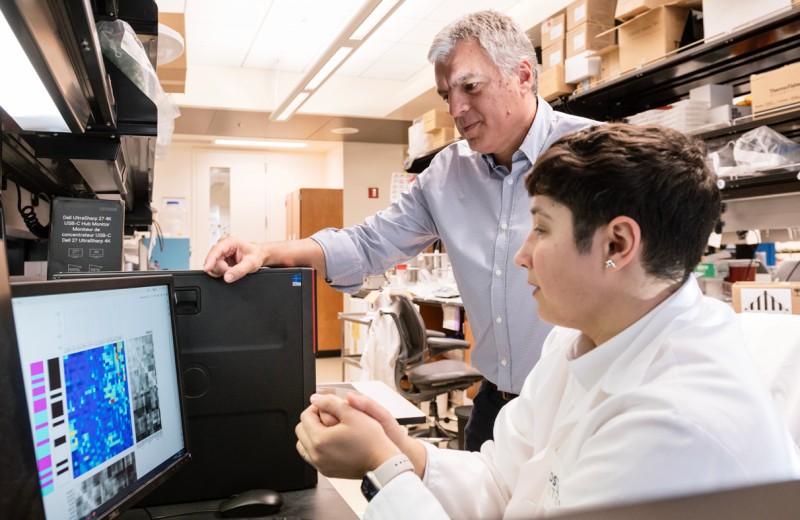
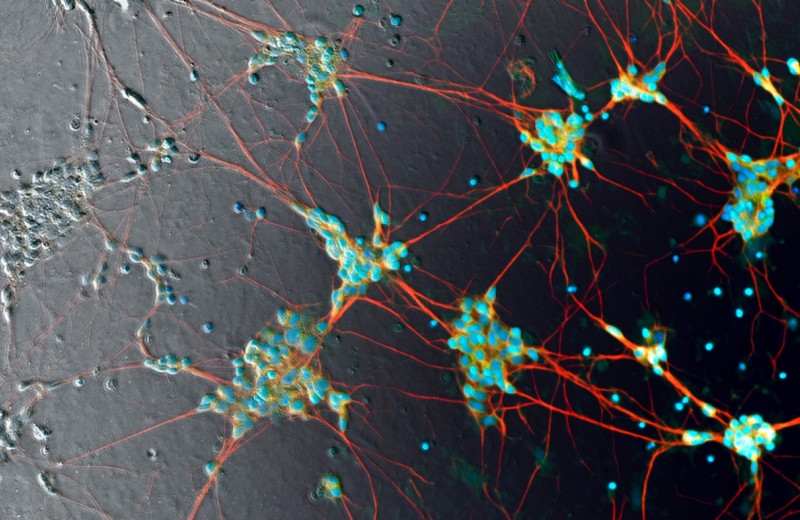
Shijie Wang, a postdoctoral scholar in Steve Finkbeiner’s lab, uses artificial intelligence, robotics, and stem cell technologies to uncover how brain cells die in neurodegenerative diseases like Alzheimer’s and Parkinson’s.
In this video, Steve Finkbeiner and Jeremy Linsley showcase Gladstone’s groundbreaking “thinking microscope”—an AI-powered system that can design, conduct, and analyze experiments autonomously to uncover new insights into diseases like Alzheimer’s, Parkinson’s, and ALS.
A powerful computation tool integrates different forms of biological data to reveal how cell types are related across tissues, experiments, and species—information that’s crucial for understanding disease.
The Voice of San Francisco—Gladstone President Deepak Srivastava reflects on how uncertainties about federal research funding are jeopardizing scientists’ efforts to find new disease cures.
The San Francisco Experience—In a podcast interview, Gladstone President Deepak Srivastava discusses the mission of Gladstone Institutes, and describes how advances in stem cell biology, genome engineering, and artificial intelligence are making it possible to understand the core of diseases and develop new cures.
Bruneau, director of the Gladstone Institute of Cardiovascular Disease, shares exciting recent advances in heart research and talks about the impact of predictive AI.
Nature—Amid pandemic upheaval, researchers—including Gladstone Investigator Nadia Roan—have gained fundamental insights about how the body fends off infections.
Science—In this Perspective article in Science, Gladstone investigator Christina Theodoris shares insights on a new AI model known as Evo that can deduce how bacterial and viral genomes operate—and then use that information to design new proteins and even whole microbial genomes. (Subscription required.)
ABC7 News—Gladstone's president Deepak Srivastava, and Katie Pollard, director of the Gladstone Institute of Data Science and Biotechnology, explain how scientists are using artificial intelligence to pinpoint the best ways to treat cancer.
The Voice of San Francisco—Gladstone President Deepak Srivastava, MD, talks about technologies driving the next wave of medicine, the importance of philanthropy dollars in fueling scientific breakthroughs, and how biotech is still breathing life into San Francisco's Mission Bay neighborhood.
A new study in Nature Genetics expands our understanding of immune regulation and autoimmunity—with findings that could also be used in the development of cancer immunotherapies.
A team of researchers from Gladstone Institutes and UC San Francisco combined high-throughput experiments and machine learning to analyze more than 100,000 sequences in human brain cells.
The American Association for the Advancement of Science (AAAS), one of the world’s largest general scientific societies, has elected Gladstone Senior Investigator Katie Pollard, PhD, into its new class of AAAS Fellows, a lifetime honor within the scientific community.
GenomeWeb—The Biswas Family Foundation and the Milken Institute have awarded nearly $14 million in grants to researchers developing artificial intelligence and other computational tools for clinical applications. The money will go to five groups, including one from the Gladstone Institutes that is developing machine-learning models to personalize colorectal and skin cancer diagnosis and treatment.
The Biswas Family Foundation and Milken Institute announce funding to establish a center for computational cancer biology at Gladstone Institutes, led by Senior Investigator Katie Pollard.
The ISCB Fellows program is a prestigious recognition within the field of computational biology honoring those who have made outstanding contributions to the discipline. These distinguished scientists and professionals have demonstrated exceptional leadership, research, and service, advancing the frontiers of computational biology and bioinformatics.
New York Times—Several new artificial intelligence-powered programs are setting their sights on the fundamentals of biology. They are not simply tidying up the information that biologists are collecting. They are making discoveries about how genes work and how cells develop. Gladstone Assistant Investigator Christina Theodoris shares her journey of creating the deep learning model GeneFormer.
Nature Podcast—Assistant Investigator Christina Theodoris explains how she and her collaborators used artificial intelligence to uncover how genes work together to control cells and tissues, even in situations such as rare diseases where data are in limited supply.
Gladstone researchers design a new artificial intelligence approach to simultaneously follow hundreds of cells in the lab as they divide, move, and interact
Nature—Advances in artificial intelligence are enabling scientists to make discoveries from images of cells, by detecting features and patterns that are invisible to the human eye. Senior Investigator Steve Finkbeiner explains how his lab trained an algorithm to detect structures inside unlabeled cells, and differentiate live from dead cells.
With a tool capable of taking large sets of data and distilling it into patterns, researchers at Gladstone hope to better predict COVID-19 patient outcomes and improve patient care.
These tiny versions of the heart, brain, intestine, lungs, and other organs are transforming how we research human disease and development at Gladstone and beyond.